S1 vs S1P vs S3 Safety Boots Explained: Which Rating Do You Need?
Posted by Tiger Supplies on 7th Sep 2026
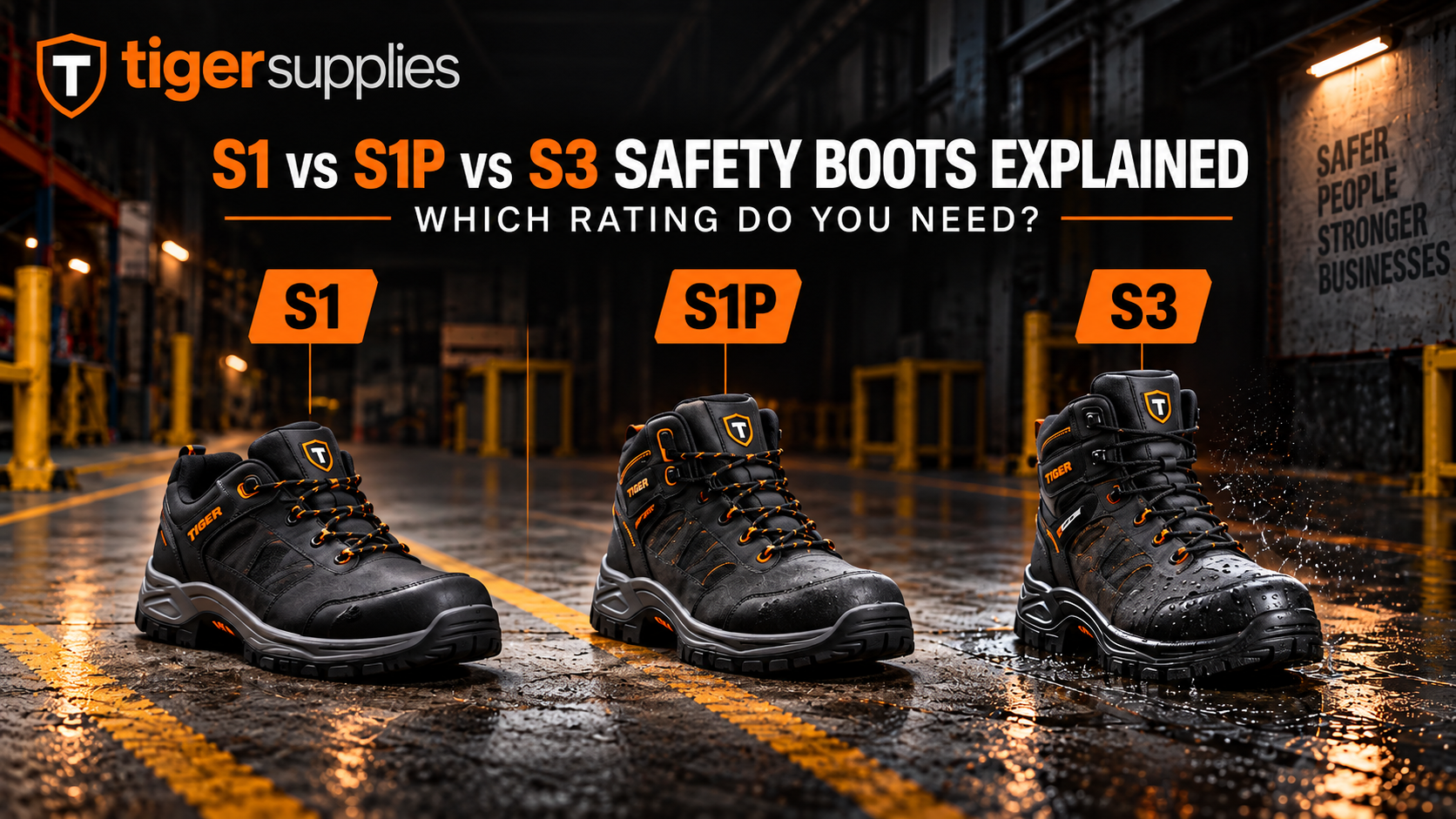
Not all safety boots are created equal. The EN ISO 20345 standard defines five ratings: S1, S1P, S2, S3, and S4 but three dominate UK workplaces: S1, S1P, and S3.
The right choice depends on your workplace hazards, not your job title. Whether you're working in a warehouse, on a construction site, or in a manufacturing facility, understanding the difference between these ratings can mean the difference between adequate protection and serious injury.
In this guide, we'll break down exactly what each rating means, what protection it offers, and most importantly, which one you actually need for your job.
What Is S1? Entry-Level Protection for Dry Environments
S1 rated safety boots are the entry-level standard for safety footwear. They're ideal for dry indoor work where the primary hazard is impact or compression to the toes. If your workplace is climate-controlled, indoors, and free from sharp objects, S1 is likely sufficient.
S1 Safety Boots Protection Features:
- Steel or composite toe cap: Protects against impact and compression (200 joules impact resistance, the EN ISO 20345 standard minimum)
- Anti-static properties: Reduces the likelihood of electrostatic discharge, critical in electronics or chemical environments
- Energy-absorbing heel: Reduces impact on joints and the lower back during prolonged standing or walking
- Oil-resistant sole: Prevents slipping on oily or greasy floors
When To Wear S1 Boots:
S1 safety boots are perfect for warehouse workers, logistics staff, and light industrial work where conditions remain relatively dry and predictable. Warehouse workers, logistics staff, and light industrial work benefit most from S1 protection. They're comfortable for all-day wear and provide essential baseline protection without the added bulk of higher ratings.
What Is S1P? Adding Anti-Perforation Protection
S1P safety boots take S1 and add one critical feature: anti-perforation protection. The 'P' literally stands for 'Perforation' meaning these boots protect against sharp objects piercing through the sole.
S1P Safety Boots Protection Features:
- All S1 features: Toecap, antistatic properties, and energy-absorbing heel
- Anti-perforation midsole: Protects against sharp objects like nails, spikes, glass, and metal shards piercing the sole
- Same water resistance as S1: Important note: S1P is NOT waterproof. It offers no protection against water exposure
When Perforation Risk Matters:
Construction sites, manufacturing floors, and logistics hubs where nails, broken glass, or metal fragments are present. S1P is ideal if your workplace has occasional sharp object hazards but doesn't involve water or mud exposure.
S1 VS S1P Comparison:
S1P costs slightly more than S1 but adds critical protection against nails, spikes, and glass. If you're unsure whether you need anti-perforation, ask yourself: "Could a nail, glass shard, or metal fragment pierce my sole?" If yes, upgrade to S1P.
What Is S3? Maximum Protection for Hazardous Sites
S3 is the highest common safety rating and is mandatory on most UK construction sites. It's the industry standard for hazardous environments where you face multiple simultaneous risks.
S3 Safety Boots Protection Features:
- All S1P features: Toecap, antistatic, anti-perforation midsole
- Water-resistant upper: Minimum 60 minutes of water resistance (the EN ISO 20345 standard requirement), keeping feet dry in wet conditions
- Cleated anti-slip outsole: Provides enhanced grip on wet, muddy, or slippery surfaces
- Enhanced grip: Prevents slipping on wet floors, muddy ground, and uneven terrain
What Makes S3 Different:
S3 boots combine anti-perforation protection WITH waterproofing, making them suitable for construction, deep water/mud exposure, and sharp object hazards. Unlike S1, which is best for dry indoor work, S3 is suitable for both indoor AND outdoor environments. Most construction sites require S3 due to HSE regulations and the combination of hazards present such as sharp objects, wet ground, and varying weather conditions.
Real-world Use Cases:
Construction workers, industrial sites, and high-risk environments where conditions are unpredictable and hazards are multiple. We stock a range of waterproof safety boots including our women's S3 safety boots for diverse team needs.
S1 vs S1P vs S3: Quick Comparison Table
|
Feature |
S1 |
S1P |
S3 |
|
Toecap Protection |
✓ (200J) |
✓ (200J) |
✓ (200J) |
|
Antistatic |
✓ |
✓ |
✓ |
|
Energy-Absorbing Heel |
✓ |
✓ |
✓ |
|
Anti-Perforation |
✗ |
✓ |
✓ |
|
Water Resistant |
✗ |
✗ |
✓ (60+ mins) |
|
Anti-Slip Outsole |
Standard |
Standard |
Cleated |
|
Best For |
Dry indoor |
Indoor + light outdoor |
Wet sites, construction |
|
Cost Range |
£30–£60 |
£40–£80 |
£60–£120+ |
Which Safety Boot Rating Do You Need?
Choosing the right safety boot rating comes down to understanding your workplace hazards. Use this decision framework:
- Is your workplace wet or muddy?
You need S3. Water resistance is non-negotiable for outdoor work or wet environments.
- Are there sharp objects present (nails, glass, spikes)?
You need S1P minimum, but S3 is recommended if water is also a factor.
- Is it dry, indoor, with no sharp hazards?
S1 is sufficient. You don't need to overspend on unnecessary protection.
- Are you working outdoors in any weather?
S3 is mandatory. Outdoor exposure requires comprehensive protection.
Legal note: Always check your workplace risk assessment and HSE guidance. S3 is the standard requirement for construction sites due to the variety of hazards present. Never choose a lower rating because it's cheaper, workplace safety regulations exist for a reason, and your employer is legally responsible for providing appropriate PPE.
At Tiger Supplies, we stock a full range of safety boots across all three ratings. Whether you need our S1 safety boots for warehouse work, S1P safety boots for mixed-risk environments, or S3 safety boots for construction, you'll find options designed for durability and all-day comfort.Browse our view all work boots collection to compare styles, brands, and price points across all safety ratings.
FAQ: Common Questions About Safety Boot Ratings
Are S3 safety boots waterproof?
S3 boots are water-resistant (minimum 60 minutes of submersion resistance per EN ISO 20345), not fully waterproof. This means they keep your feet dry during typical wet conditions such as rain, puddles, wet concrete but are not designed for prolonged immersion. For workers in deep water or consistently wet environments, choose wellington-style S3 boots with extended water resistance claims.
Can I wear S1 boots outdoors?
Technically yes, but it's not recommended. S1 lacks water resistance, so your feet will get wet in rain or on wet ground. If you're working outdoors, use S2 minimum for fair weather; S3 for wet conditions. The few pounds saved on cheaper S1 boots isn't worth soggy, cold feet for eight hours.
Do I need S3 for construction?
Most construction sites require S3 due to HSE regulations and the nature of on-site hazards (sharp objects, wet ground, varying conditions). Check your site's risk assessment and your employer's PPE policy, but expect to need S3 if you're working in construction, demolition, or groundworks.
What's the difference between S1P and S3?
S1P adds anti-perforation protection to the S1 base but lacks water resistance. S3 adds BOTH anti-perforation AND waterproofing plus an anti-slip cleated outsole. S3 is the more comprehensive protection and is better for harsh, unpredictable sites. If you're choosing between the two, S3 is the safer bet.