Traffic Cone Lights for UK Roadworks: How to Choose, Power and Fit Them Safely
Posted by Tiger Supplies on 11th Oct 2026
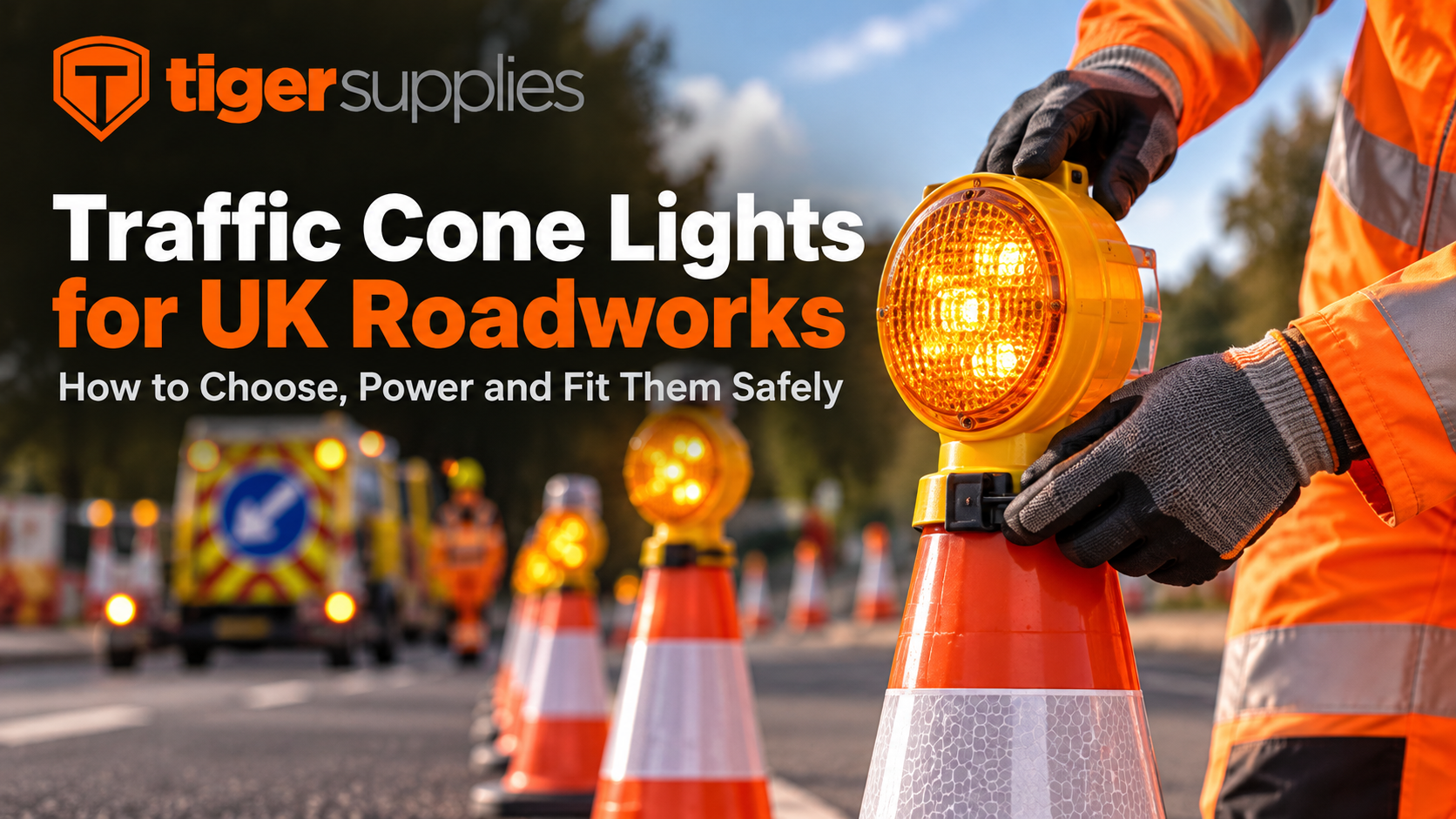
Night-time and low-visibility roadworks depend on clear warning. The right traffic cone lights show drivers where a lane closure starts and how to move over safely. The wrong ones can fail, drain their batteries or come loose in the wind.
This guide covers the main cone light patterns, power options, switching, fitting, compliance and daily checks, so the site managers and contractors in the UK can understand the difference and use lights with confidence.
Why Cone Lights Matter on Night And Low-visibility Roadworks?
A lit cone line marks the edge of a closure before a driver reaches it. In darkness, fog or heavy rain, lights make the closure easier to see and give drivers more time to react. They also mark the boundary between live traffic and your workforce, so lights should never be treated as an optional extra.
Steady, Flashing and Sequential: Which One To Use?
- Steady or continuous: a constant light for a fixed warning. The red cone lamp with a metal bracket offers both continuous and flashing modes.
- Flashing: a pulsing light that draws attention to a hazard. The flashing cone lamp with a photocell option flashes continuously without the photocell, and switches on at dusk with it.
- Sequential: lamps that flash one after another along a taper, guiding drivers away from a closed lane. The sequential taper lamp synchronises itself, and any lamp can go in any position.
Check the pattern against your traffic management plan before you order.
Battery Power: Options and Run Times
Battery type and run time vary by lamp, and many lamps need a battery bought separately. Check before you order, and keep spares on site for long closures.
- Sequential taper lamp: runs for up to 125 hours on a standard 6V battery. Each lamp needs one, available as a 6V battery for sequential taper lamps.
- Flashing cone lamp: the manufacturer’s data sheet gives average battery life of 65 hours with the photocell and 40 hours without it. Batteries are not supplied, so buy them separately. See the flashing cone lamp with a photocell option.
- Red cone lamp: runs on one 6V battery, which you can buy from our range. See the red cone lamp with a metal bracket.
Automatic, Solar and Photocell Switching
Switching decides how much attention a lamp needs once it is on site.
- Automatic switch-on: the magenta cone light and the sequential taper lamp switch on once placed onto a cone.
- Daytime energy saving: the magenta cone light has a built-in switch that saves power during the day.
- Solar switch: the red cone lamp has an automatic solar switch, so it works without manual setup.
- Photocell: the flashing cone lamp with a photocell option switches on at dusk, which saves battery life.
How To Fit Lights To Cones?
Fitting varies by model, so check the bracket before you deploy.
- Integrated bracket: the magenta cone light and the sequential taper lamp include an integrated cone bracket, with no tools or keys required.
- Metal bracket: the red cone lamp comes with a metal cone bracket and a locking battery compartment.
- Separate bracket: some flashing lamps use a bracket sold separately. Confirm whether you need one for your cone type before ordering.
Before deployment, check that every lamp is secure on its cone.
Lens, Colour and Visibility
- The flashing cone lamp with a photocell option has a 360° lens for all-round visibility, moulded from impact-resistant polycarbonate.
- The red cone lamp has a 180mm polycarbonate lens.
- The magenta cone light is 186mm across and shows a magenta light.
- The sequential taper lamp has a static amber backup light that stays on during the sequential flash.
Colour should suit your site rules and your traffic management plan.
What Makes a Cone Light Compliant in the UK?
Compliance is essential on every UK roadworks site. Every cone light you use should be compliant with UK traffic management rules and the British standards that apply. Non-compliant equipment can harm road users and leave your business exposed, so check before you buy.
The key standards are:
- BS 3143 Part 2 (1990): the original specification for battery-operated road danger lamps. It was superseded in 2008.
- BS EN 12352:2006: the current British standard for warning and safety light devices. The European version was updated in 2024, so confirm the latest edition when you buy.
Some of our cone lights list conformity to these standards. Check the listing for cone lights that conform to the current standard. For the flashing lamp, conformity applies with an amber lens, so confirm the lens colour before ordering.
Consult Chapter 8 of the Traffic Signs Manual for temporary traffic management on UK roads. This article is general guidance, not legal advice.
Daily Maintenance and Checks On Site
- Check batteries at the start of each shift, and replace any that are low.
- Clean lenses with soapy water and air-dry them, as the manufacturer advises for the flashing lamp.
- Confirm sync on sequential lamps: the red LED at the rear shows when a lamp is synchronised.
- Inspect lenses, brackets and battery compartments, and replace any damaged unit.
- Check locks on battery compartments after every battery change.
Conclusion
Choosing the right traffic cone light comes down to the site in front of you. Consider road speed, how long the closure will run, the power and battery options, how the lamp switches on, how it fits the cone, and whether it conforms to BS EN 12352. Get those right, and your lights will do their job every night. For the full range of lights, brackets and accessories, browse our cone accessories range.
Frequently Asked Questions
How far apart should cones be placed on site?
Spacing depends on road speed, the layout of the works and whether you are setting up a closure or a taper. Use the spacing in your traffic management plan, and check it against Chapter 8 of the Traffic Signs Manual before you set out.
Do cones need lights at night?
Lights matter most in darkness and low visibility. Your traffic management plan should specify the lamp type and spacing for night working.
Which UK standard applies to cone lights?
BS EN 12352 is the current British standard for warning and safety light devices. The older BS 3143 Part 2 (1990) was superseded in 2008.
Do cone lights need to be compliant on private sites?
This guide covers public highways and roadworks. On private sites, check your site rules and insurance requirements with your safety adviser.