EN388 Gloves Explained: What the Rating Means and How to Choose the Right Safety Gloves
Posted by Tiger Supplies on 1st May 2026
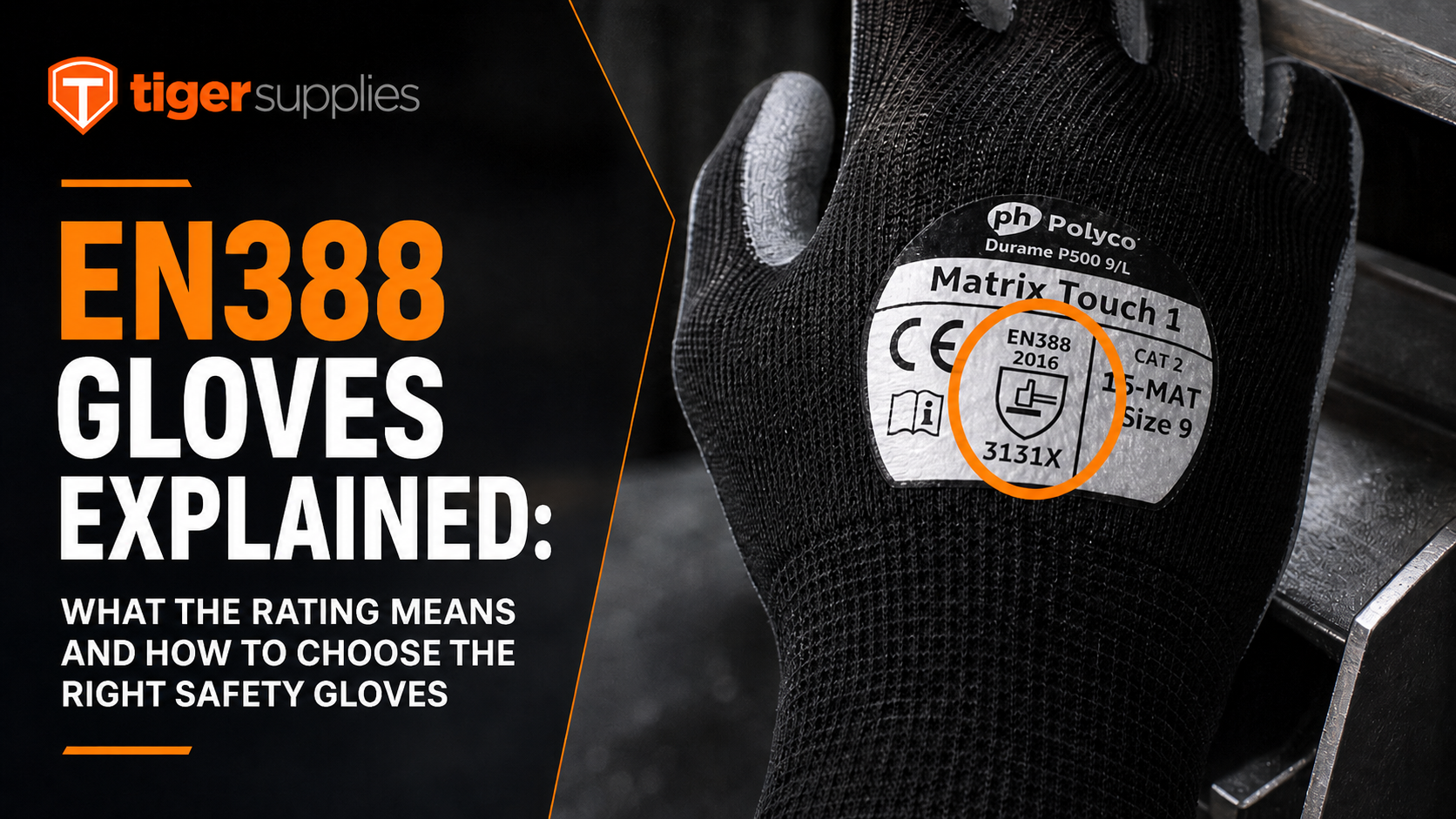
EN388 is one of the most common glove standards for businesses in the UK used to assess protection against mechanical risks such as abrasion, cuts, tears, punctures, and impact.
In this guide, we’ll explain what EN388 means, how to read the glove rating, what the numbers and letters stand for, and how to choose suitable safety gloves for different workplace tasks.
Why EN388 Gloves Matter for UK Workplaces
EN388 gloves help UK businesses choose safety gloves based on tested performance, not guesswork. This is especially useful for teams working in construction, warehousing, manufacturing, maintenance, logistics, or site handling roles.
The EN 388 standard does not mean one glove is automatically “better” than another. It shows how that glove performed in specific mechanical safety tests. That matters because a glove used for light handling may not need the same rating as a glove used around sharp materials, rough surfaces, or heavy-duty site work.
What Does EN388 Mean on Gloves?
EN388 is the European standard used to test safety gloves against mechanical risks. These are the types of risks commonly found in workplace tasks where hands may come into contact with rough surfaces, sharp materials, tools, machinery, or heavy items.
An EN388 rating shows how a glove performs against specific hazards, including abrasion, blade cut, tear, puncture, and in some cases, impact protection. This helps businesses compare gloves more clearly instead of choosing only by material, thickness, or price.
You will usually find the EN388 marking on the glove, packaging, product label, or product specification. It is normally shown with a shield-style pictogram and a sequence of numbers and letters. These characters tell you how the glove performed in each test.
For example, a glove marked EN388 4121X has been tested across different mechanical protection areas. The numbers and letters are not random. Each one represents a specific part of the glove rating.
What Do EN388 Glove Ratings Mean?
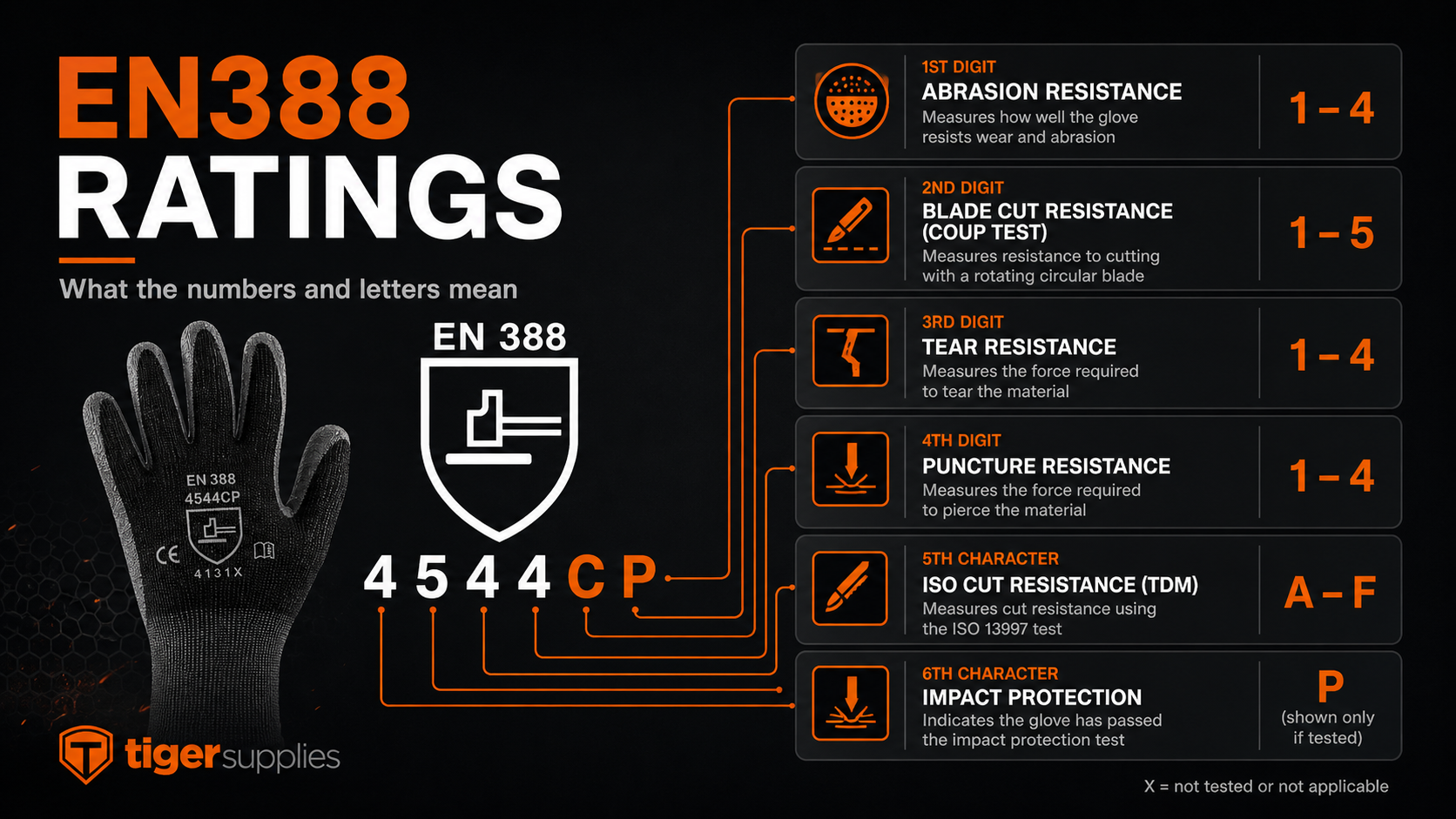
EN388 glove ratings are shown as a sequence of numbers and letters. Each character explains how the glove performed in a different mechanical safety test.
The first four numbers usually show performance for:
- Abrasion resistance
- Cut resistance
- Tear resistance
- Puncture resistance
After those numbers, you may also see a letter from A to F. This relates to the newer straight blade cut test, also known as the TDM cut test. In simple terms, this helps show how well the glove performs against more demanding cut risks.
You may also see P, F, or X at the end of an EN388 rating. P means the glove passed the impact protection test. F means it failed. X usually means the test was not carried out or was not applicable for that glove.
So, if a glove shows a rating such as EN388 4544CX, each number and letter gives information about a different type of protection. This helps buyers understand whether the glove is suitable for light handling, general site work, cut-risk tasks, or heavier workplace use.
EN388 Glove Rating Chart
The EN388 glove rating chart helps explain what each number or letter in the rating code means. This is useful when comparing safety gloves for different workplace risks, especially where cut resistance, abrasion resistance, tear strength, or puncture protection matters.
|
Rating Position |
Test |
What It Measures |
Rating Scale |
|
1st number |
Abrasion resistance |
How well the glove resists rubbing, scraping, and surface wear |
1–4 |
|
2nd number |
Cut resistance / Coup test |
How well the glove resists a rotating blade cut test |
1–5 |
|
3rd number |
Tear resistance |
How much force the glove can take before tearing |
1–4 |
|
4th number |
Puncture resistance |
How well the glove resists puncture from a rounded point |
1–4 |
|
5th character |
TDM cut resistance |
How well the glove resists a straight blade cut test |
A–F |
|
6th character |
Impact protection |
Whether the glove has passed impact protection testing |
P, F, or X |
A higher rating usually means stronger performance in that specific test. However, it does not automatically mean the glove is right for every task. A glove still needs to match the working environment, hazard level, grip requirement, and dexterity needed by the wearer.
EN388 Cut Ratings Explained
Cut resistance is one of the most important parts of an EN388 glove rating, especially for businesses handling sharp tools, sheet metal, glass, blades, packaging materials, or rough construction products.
There are two cut ratings you may see on EN388 gloves.
The older Coup cut test is shown as the second number in the rating code. It uses a scale from 1 to 5, with 5 showing the highest result for that test.
The newer TDM cut test is shown as a letter from A to F. This test uses a straight blade and is designed to give a clearer result for gloves used in higher cut-risk environments. In simple terms, A is the lowest TDM cut rating and F is the highest.
For example, a glove with a rating such as EN388 4544CX has both the older cut test number and the newer TDM cut letter included. This gives buyers a more complete picture of how the glove performs against cut risks.
For low-risk handling, the highest cut rating may not be necessary. For tasks involving sharp materials, blades, or metal edges, the TDM cut rating becomes more important.
Common EN388 Glove Ratings: 2121, 3131X, 4121X and 4544CX
EN388 ratings can look confusing at first, but common rating codes become easier to understand once you know what each character represents. The examples below show how different EN388 glove ratings may be interpreted in workplace buying decisions.
|
Example Rating |
What It Usually Suggests |
Typical Use Case |
|
EN388 2121 |
Basic mechanical protection with lower cut, tear, and puncture performance |
Light handling, low-risk general tasks, basic warehouse work |
|
EN388 3131X |
Better abrasion and general handling performance, with no impact test shown |
General handling, packing, logistics, light site work |
|
EN388 4121X |
Strong abrasion resistance with moderate protection in other areas |
Construction handling, maintenance, site work, rough surface handling |
|
EN388 4544CX |
High mechanical performance with strong cut and puncture protection |
Cut-risk tasks, metal handling, glass handling, heavier industrial work |
These examples should be used as a guide, not as a replacement for checking the product specification. The right EN388 gloves depend on the actual task, the material being handled, the level of grip needed, and whether the wearer needs flexibility or heavier protection.
For businesses comparing different types of workplace gloves, Tiger Supplies’ safety gloves and gauntlets range can help you review suitable options by task and protection requirement.
How to Choose EN388 Gloves for Different Workplace Tasks?
The right EN388 gloves depend on the task, not just the highest rating. A glove used for light warehouse handling does not need the same protection as a glove used for metal handling, glass work, demolition, or heavy site work.
Use the table below as a practical guide.
|
Workplace Task |
What to Prioritise |
Useful EN388 Rating Focus |
|
Warehouse handling |
Grip, comfort, flexibility, abrasion resistance |
Abrasion and tear resistance |
|
Construction and site work |
Rough surface handling, puncture resistance, durability |
Abrasion, tear, and puncture resistance |
|
Metal or glass handling |
Protection against sharp edges |
TDM cut rating A–F |
|
Maintenance work |
Dexterity, grip, and general protection |
Balanced EN388 rating |
|
Packing and logistics |
Light handling, comfort, and repeat use |
Abrasion resistance and grip |
|
Demolition or heavy-duty work |
Impact, puncture, and cut protection |
Higher abrasion, puncture, cut, and impact protection where needed |
For UK businesses buying safety gloves for teams, it is worth matching the glove rating to the actual risk. If workers need precision, a very thick glove may reduce control. If workers handle sharp materials, cut resistance becomes more important. If the task involves rough surfaces, abrasion resistance may matter more than cut rating.
For broader glove options, you can review Tiger Supplies’ protective work gloves by task, material, and workplace requirement.
Is a Higher EN388 Rating Always Better?
A higher EN388 glove rating does not always mean the glove is better for every job. It only means the glove performed strongly in that specific test.
For example, a high cut-resistant glove may be useful for handling metal, glass, or sharp materials, but it may not be the best choice for tasks that need fine movement or fingertip control. A thicker glove can sometimes reduce dexterity, grip, and comfort over a full working day.
The same applies to tear resistance. In some machinery-related tasks, a glove that tears away more easily may reduce the risk of the hand being pulled further into danger. This depends on the task and should always be considered as part of a proper workplace risk assessment.
The best EN388 gloves are not always the gloves with the highest numbers. They are the gloves that match the hazard, working environment, comfort needs, grip requirement, and level of movement needed by the wearer.
EN388 2003 vs EN388 2016: What Changed?
The EN388 standard was updated in 2016 to give a clearer view of glove performance, especially for cut resistance.
Older EN388 ratings were usually shown with four numbers. These covered abrasion resistance, cut resistance, tear resistance, and puncture resistance. This older format was useful, but it did not always give enough detail for higher cut-risk gloves.
The 2016 update added the newer TDM cut test, shown as a letter from A to F. This test uses a straight blade and gives a more reliable result for gloves designed for stronger cut protection.
The 2016 version may also show impact protection, usually marked as P, F, or X. P means the glove passed the impact test. F means it failed. X means the test was not carried out or was not applicable.
This is why some EN388 gloves show a shorter rating, while others show a longer code with both numbers and letters. When comparing gloves, always check the full rating and the product specification, especially if the glove will be used for cut-risk or heavy-duty tasks.
Where to Buy EN388 Gloves in the UK?
For UK businesses, EN388 gloves should be selected based on the task, risk level, comfort, grip, and required protection rating. The right glove should protect the wearer without making the job harder to carry out.
If you are buying for construction, warehousing, manufacturing, maintenance, logistics, or general site work, check the EN388 rating alongside the product material, coating, size range, and intended use.
Tiger Supplies offers a range of EN388 safety gloves for workplace use, helping businesses source suitable hand protection as part of their wider PPE requirements.
Conclusion
EN388 gloves help businesses understand how safety gloves perform against mechanical risks such as abrasion, cuts, tears, punctures, and impact. Instead of choosing gloves based only on thickness, material, or price, the EN388 rating gives you a clearer way to compare protection levels for different workplace tasks.
The key is to match the glove to the job. Light handling, warehouse work, construction, metal handling, glass handling, and heavy-duty site work may all require different levels of protection, grip, comfort, and dexterity.
For businesses reviewing hand protection as part of a wider workplace safety order, Tiger Supplies’ PPE range can help you source suitable safety equipment for different working environments.
FAQs About EN388 Safety Gloves
What does EN388 mean on gloves?
EN388 means the glove has been tested against mechanical risks such as abrasion, cuts, tears, punctures, and sometimes impact protection. The rating helps buyers understand how the glove performed in each test.
What is the EN388 standard for gloves?
The EN388 standard is a European glove standard used to assess protective gloves against mechanical hazards. It is commonly used for safety gloves worn in construction, manufacturing, warehousing, logistics, maintenance, and handling work.
What do EN388 glove ratings mean?
EN388 glove ratings use numbers and letters to show test results. The first four numbers usually cover abrasion, cut, tear, and puncture resistance. Extra letters may show TDM cut resistance and impact protection.
What is the EN388 cut rating?
The EN388 cut rating shows how well a glove performs against cutting risks. The older Coup cut test uses a 1–5 scale, while the newer TDM cut test uses letters from A to F.
What does X mean in an EN388 rating?
An X means the test was not carried out or was not applicable for that glove. It does not always mean the glove has failed, but it does mean that no rating is shown for that specific test.
Are all safety gloves EN388 rated?
No. Not all safety gloves are EN388 rated. Some gloves are designed for other types of protection, such as chemical resistance, thermal protection, cold protection, hygiene, or disposable use.
Which EN388 gloves are best for UK workplaces?
The best EN388 gloves depend on the task. Light handling may need flexibility and grip, while metal handling, glass handling, construction, or heavy-duty site work may need stronger cut, puncture, abrasion, or impact protection.