Face Fit Testing Explained: What It Is, When It's Required and How to Get It Right
Posted by Tiger Supplies on 21st Aug 2026
If your team wears tight-fitting respiratory protective equipment (RPE), anything from a disposable FFP3 mask to a full-face respirator, face fit testing isn't optional extra diligence. It's the only way to know whether that mask actually protects the person wearing it.
A respirator that looks right on the shelf can still let contaminated air leak straight past the seal if it doesn't match the shape of an individual's face, and that gap is exactly what face fit testing is designed to catch.
In this guide, we'll cover what face fit testing actually involves, whether it's a legal requirement for your business, the difference between qualitative and quantitative testing, and when a test needs to be repeated. We'll also look at how facial hair affects the result, and whether you can carry out testing in-house.
What Is Face Fit Testing?
Face fit testing is a check carried out on an individual to confirm that a specific make, model and size of tight-fitting facepiece forms an adequate seal against their face. It isn't a test of the equipment in isolation, the same respirator that seals perfectly on one person can leak badly on someone with a different face shape, jawline or facial hair. That's why fit testing has to be done per person, per mask.
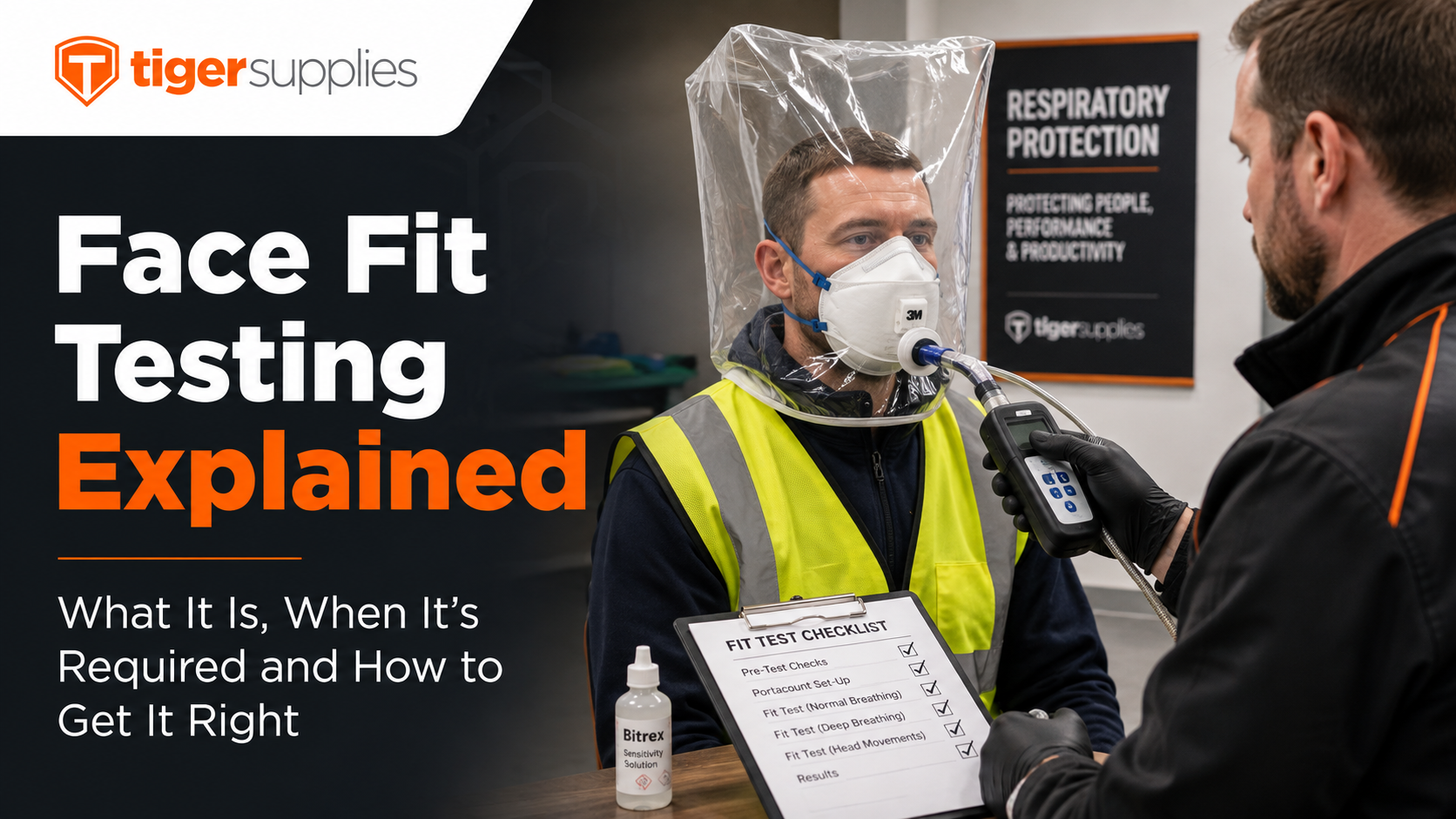
There are two recognised approaches. A qualitative face fit test relies on the wearer's own senses: a hood is placed over their head while wearing the mask, and a bitter or sweet test solution is sprayed inside. If they can taste it, the mask has failed. This method is used for filtering facepieces (FFP1, FFP2, FFP3) and half masks.
A quantitative face fit test is instrument-based rather than subjective. Methods include ambient particle counting (APC), controlled negative pressure (CNP) and condensation nuclei counting (CNC), and these can be used on half masks and full face masks, giving a numerical pass/fail result rather than relying on taste.
Is Face Fit Testing a Legal Requirement in the UK?
Yes. Under UK regulations including COSHH, the Control of Lead at Work Regulations (CLAW), the Control of Asbestos Regulations (CAR) and the Ionising Radiations Regulations, employers have a legal duty to ensure that any tight-fitting RPE provided to employees has been face fit tested. The Health and Safety Executive sets this out in guidance document INDG479 and in the HSG53 handbook, both of which make clear that fit testing should happen at the initial selection stage, before RPE is issued for use, not as an afterthought.
The reasoning is simple: RPE can only protect the wearer if it forms a proper seal, and since people's faces vary enormously in shape and size, there's no such thing as a mask that fits everyone. Skipping the test means you genuinely don't know whether the RPE you've issued is doing its job.
How Often Should Face Fit Testing Be Repeated?
A pass isn't necessarily permanent. Retesting is needed if the wearer changes the make, model or size of mask, and it should also be repeated if their facial characteristics change in a way that could affect the seal, significant weight gain or loss, major dental work, or a change in facial hair are the most common triggers. If a worker uses more than one type of tight-fitting facepiece, each one needs its own fit test, since a pass on one model doesn't carry over to another.
Does Facial Hair Affect Face Fit Testing?
This is worth calling out on its own, because it trips a lot of workplaces up. Stubble and beards sitting along the seal line of a mask make it effectively impossible to get a reliable seal, no matter how good the respirator is. HSE guidance is direct on this: if a tight-fitting mask is required, the wearer needs to be clean-shaven along the seal area, or the answer is to use RPE that doesn't rely on a tight facial seal, such as a powered air-purifying respirator, or a hood or visor-based system instead.
Can You Carry Out Face Fit Testing In-House?
You don't have to outsource face fit testing to a specialist visiting your site, but the test still has to be carried out by a competent person, someone appropriately trained and experienced, ideally holding accreditation through a recognised scheme such as Fit2Fit. Many businesses that carry out regular RPE fit checks choose to buy their own qualitative face fit testing kit and train a member of staff to competency, which works out considerably cheaper over time than booking in an external tester every time a new starter joins or a mask model changes. If that's the route you're considering, our Face Fit Test Kits range covers the equipment needed to carry out qualitative testing in-house.
Whichever mask type your team relies on, it's worth pairing the right RPE with the right testing approach. Disposable filtering facepieces are typically qualitative-tested, while reusable respirators are more commonly quantitative-tested, and if your current stock needs replacing or servicing, our Respirators and Disposable Masks ranges, along with Respirator Filters & Accessories for ongoing maintenance, cover both ends of that requirement.
Conclusion
Face fit testing isn't a box-ticking exercise, it's the difference between RPE that actually protects your team and RPE that just looks like it does. Get the method right, retest when it matters, and the rest of your PPE Regulations UK obligations become far easier to stay on top of.
Face Fit Testing FAQs
How much does a face fit test cost?
Costs vary depending on whether you use an external tester or carry it out in-house with your own kit and a trained member of staff AAA buying testing equipment outright is usually the more cost-effective option for businesses that fit test regularly.
How long does a face fit test take?
A single qualitative or quantitative test typically takes 15 to 25 minutes per person, though this depends on the method used and how many mask sizes or models need to be tried.
Is face fit testing a legal requirement?
Yes, under COSHH and related regulations, employers must ensure tight-fitting RPE is face fit tested before it's issued for use, and retested whenever the mask model changes or facial features are significantly altered.
Can I face fit test myself?
You can carry out testing in-house using a qualitative test kit, but the person conducting the test must be competent and appropriately trained AAA it isn't something an untrained employee should attempt on colleagues.