Health and Safety Signs For UK Businesses Explained: Types, Colours and What They Mean
Posted by Tiger Supplies on 14th Jul 2026
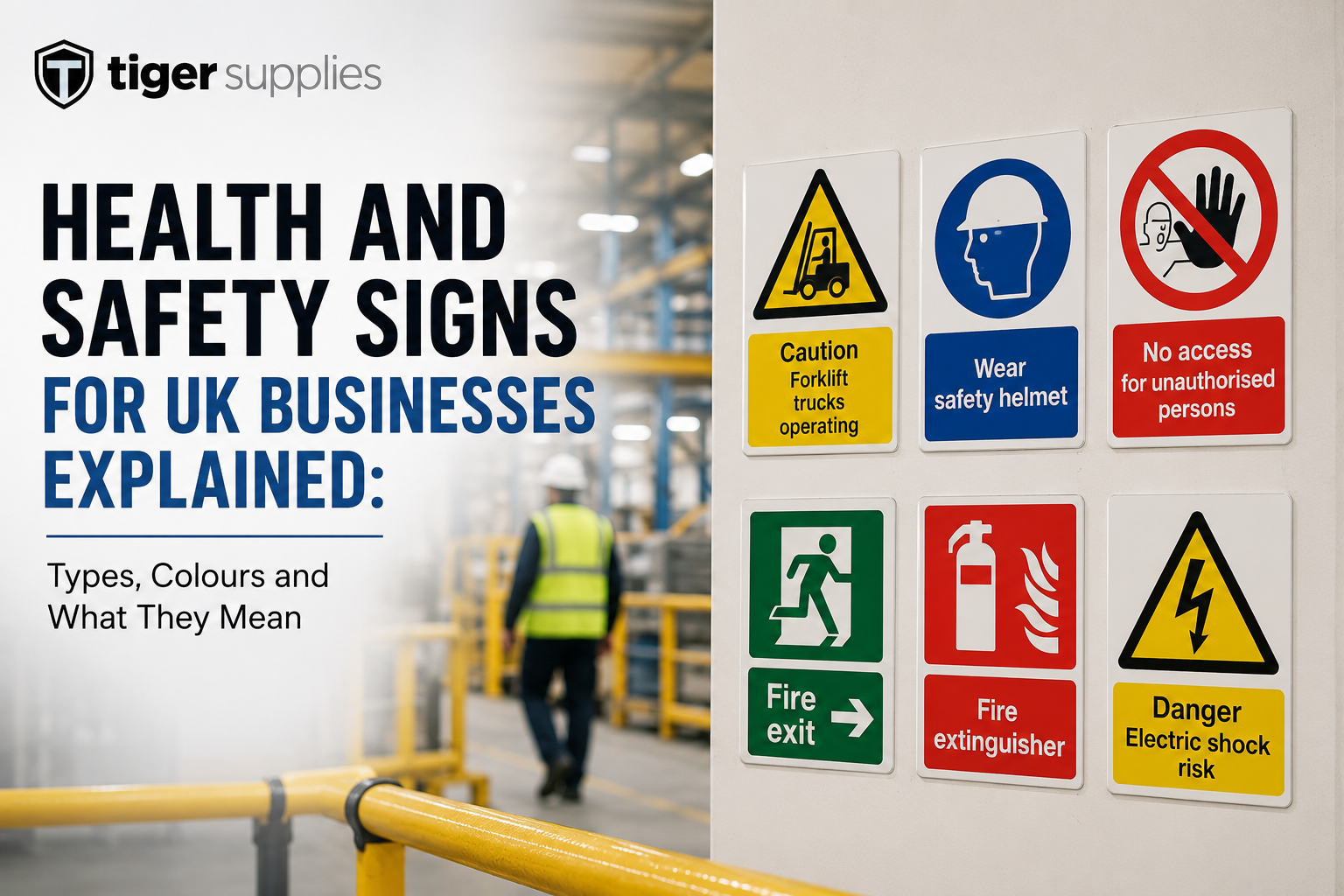
A health and safety sign is any sign that communicates a safety instruction, a hazard, or emergency information using a standardized combination of colour, shape and symbol, rather than relying on written text alone.
In the UK, these signs aren't just good practice, they're a legal requirement under the Health and Safety (Safety Signs and Signals) Regulations 1996 wherever a risk can't be removed or controlled by other means. There are five legally recognised categories, each with its own colour and shape, and understanding them takes the guesswork out of choosing, placing, or interpreting signage on site.
This guide covers what each type means, what the colours and shapes tell you at a glance, and how fire safety signage differs from a fire alarm system.
What Counts as a Health and Safety Sign (and Why It's a Legal Requirement)
Under the 1996 Regulations, employers must provide safety signs wherever a significant risk to health and safety remains after other precautions have been taken, for example, marking a fire exit, warning of a chemical hazard, or instructing that PPE must be worn in a specific area.
The regulations require these signs to follow a standardised system of colour, shape and pictogram, so the meaning is understood instantly regardless of the language someone speaks.
This is what separates a "health and safety sign" from general signage: it's not just informative, it's a defined legal category with specific design rules attached. Getting the type, colour and shape right isn't a design choice, it's what makes a sign compliant.
The Five Types of Health and Safety Signs Used in UK Workplaces
There are five categories of health and safety sign, and each is identifiable by colour and shape alone, before you even read the symbol.
|
Type |
Colour & Shape |
Meaning |
Example |
|
Prohibition |
Red, circular |
Stops an action |
No Smoking |
|
Mandatory |
Blue, circular |
An action must be carried out |
Ear Protection Must Be Worn |
|
Warning |
Yellow, triangular |
Alerts to a hazard |
Caution: Forklift Trucks |
|
Safe Condition |
Green, rectangular/square |
Shows safe routes or facilities |
Fire Exit, First Aid Point |
|
Fire Equipment |
Red, rectangular/square |
Marks fire-fighting equipment location |
Fire Extinguisher Here |
Prohibition signs are the ones to reach for whenever you need to stop a specific behaviour outright, no entry, no naked flames, no unauthorised access, and Tiger Supplies' range of prohibition signs covers the most commonly required variants for UK worksites.
Mandatory signs work the other way round, instructing that something must be done before entering an area, most often PPE requirements, and you'll find the full set in our mandatory signs range.
Warning signs flag a hazard that requires caution rather than an outright ban, from moving vehicles to electrical risk, and our hazard signs collection is built around the situations most workplaces actually encounter.
Safe condition signs point people toward safety, fire exits, assembly points, first aid, and our safe condition signs are designed to stay legible even in an emergency.
Fire equipment signs are the odd one out colour-wise (red, like prohibition signs, but rectangular rather than circular) because they mark the location of a fire-fighting kit rather than banning an action, and our fire equipment signs make that kit easy to find under pressure.
How to Identify Safety Signs by Their Colour and Shape
Once you know the system, you can identify a sign's category from across a room, before reading a single word.
Colour tells you the type of message: red means stop or danger-equipment, blue means an action is required, yellow means caution, and green means safety or "this way."
Shape reinforces it independently of colour, which matters for anyone with colour vision deficiency, circular signs either prohibit (red) or instruct (blue), triangular signs always warn, and rectangular or square signs are informational, marking either a safe condition (green) or fire equipment (red). If none of your existing stock matches a specific hazard, location or wording you need, it's often faster to specify a custom safety sign in the exact colour, shape and message required than to adapt an off-the-shelf option.
Fire Safety Signs vs Fire Alarm Systems: Don't Confuse the Two
Fire equipment signs and fire alarm systems get mixed up often, but they do completely different jobs. A fire equipment sign is a passive, static marker, red, rectangular, telling people where to find a fire extinguisher, fire blanket, or fire action notice. It doesn't detect anything or alert anyone; it just marks a location so equipment can be found quickly under pressure.
A fire alarm system, by contrast, is an active detection and warning system that senses smoke, heat or flame and triggers an audible alert across the building. If you're reviewing your fire safety setup, it's worth understanding both sides: our guide to fire alarm systems covers BS 5839 categories, grades and types for UK businesses, and if you're specifying the equipment your signage will be pointing people toward, our breakdown of fire extinguisher types explains which one suits which fire risk. Signage and detection work together, but neither one replaces the other.
Conclusion
Once you know the five categories and what their colour and shape mean, choosing or interpreting a health and safety sign stops being guesswork. If you've identified which type you need, our full signage range covers all five categories, and if none of the standard options fit your exact wording, location or branding, a custom safety sign can be made to match.
FAQs
What are the 5 main types of health and safety signs?
Prohibition, mandatory, warning and safe condition signs are the four traditional categories, with fire equipment signs commonly listed as a fifth. Each has its own colour and shape, covered in the table above.
What is a health and safety sign?
A sign that uses a standardised colour, shape and symbol to communicate a safety instruction, hazard, or emergency information, as required under the Health and Safety (Safety Signs and Signals) Regulations 1996.
Are there 4 or 5 types of safety signs?
Both answers are correct depending on the source. HSE guidance groups signs into four core categories, prohibition, mandatory, warning, safe condition, with fire equipment signs treated as a related fifth category because they follow their own colour and shape rules.
What is a mandatory sign?
A blue, circular sign instructing that a specific action must be carried out before entering an area or carrying out a task, such as wearing ear protection or PPE.
What colour are prohibition signs in the UK?
Red, always circular, used to stop or ban a specific action such as smoking or unauthorised entry.
What are the 4 colours used in health and safety signs?
Red (prohibition and fire equipment), blue (mandatory), yellow (warning), and green (safe condition), each colour maps to a specific type of instruction, detailed in the colour and shape section above.