A UK Business Guide to Fire Alarm Systems: BS 5839 Categories, Types and Testing Requirements
Posted by Tiger Supplies on 7th Jul 2026
 A fire alarm system is only doing its job if it's the right one for the building it's protecting.
Specifying the wrong category, missing the difference between a conventional and an addressable panel, or assuming BS 5839 compliance without knowing which part applies can leave you both under-protected and out of step with what a fire risk assessor or insurer expects to see.
This guide is for UK site managers, and health & safety officers who need to understand fire alarm systems well enough to specify, buy, or manage one with confidence.
We'll cover what the law actually requires, what BS 5839 says in plain English, how fire alarm categories and grades work, the difference between conventional, addressable and wireless systems, and how often a system has to be tested to stay compliant.
Is a Fire Alarm System a Legal Requirement?
Yes, under the Regulatory Reform (Fire Safety) Order 2005, every non-domestic premises in England and Wales must have a fire detection and warning system suitable for the risks identified in a fire risk assessment.
The "responsible person" (typically the employer, owner, or occupier) is legally required to assess fire risk, provide detection and warning appropriate to that risk, maintain the system in working order, and keep records to prove it.
BS 5839 itself isn't a piece of legislation, no clause anywhere says "you must comply with BS 5839."
But it's the British Standard code of practice that fire and rescue services, insurers, and building control all use as the benchmark for what "suitable" looks like in practice.
The current version for non-domestic premises, BS 5839-1:2025, is a genuinely recent revision, published in April 2025, so any system specified or serviced now should be checked against it rather than an older edition. Departing from BS 5839 without a documented, competent reason is a hard position to defend if there's ever an incident.
None of this happens in isolation from the wider compliance rules UK businesses already navigate for other equipment, the same UKCA and CE marking requirements that apply to hard hats, gloves and hearing protection also apply to fire alarm components, and our guide to UK PPE and equipment compliance marking breaks down what "compliant" actually means before you buy.
BS 5839-1 and BS 5839-6: Which Standard Applies to Your Building?
BS 5839-1:2025 is the part that matters for most commercial buyers: it's the code of practice for designing, installing, commissioning and maintaining fire alarm systems in non-domestic premises, offices, warehouses, retail units, schools, and industrial sites.
If you're specifying new equipment or replacing part of an existing setup, this is the standard your fire alarm systems should be checked against, since it's what a fire risk assessor or insurer will reference if they query your setup.
BS 5839-6 covers the domestic side, houses, flats, and HMOs, both new-build and existing. It's a different framework with its own grading system (more on that below), and it's the one that applies to landlords and residential managing agents rather than commercial site managers, so it's worth knowing which part you actually need before assuming BS 5839 means one thing.
Understanding Fire Alarm Categories: L1–L5, P1–P2 and M
BS 5839-1 categorises non-domestic systems by what they're designed to protect, life, property, or both, and how much of the building they cover.
A fire risk assessment determines which category is appropriate; it isn't a preference call for whoever's installing the system.
|
Category |
Coverage |
Typical use case |
|
L1 |
Automatic detection throughout the entire building, including voids and roof spaces |
Highest life-risk premises, care homes, hospitals, hotels |
|
L2 |
Automatic detection in escape routes plus defined high-risk rooms |
Mixed-risk buildings with specific high-risk areas (plant rooms, kitchens) |
|
L3 |
Automatic detection in escape routes and the rooms opening onto them |
Standard offices, smaller commercial premises |
|
L4 |
Detection limited to escape routes only |
Lower-risk, single-storey or small premises |
|
L5 |
Bespoke, engineered around a specific risk identified in the risk assessment |
Any building with a unique or localised hazard |
|
P1 |
Automatic detection throughout the building, for property protection |
High property/business-continuity risk |
|
P2 |
Automatic detection in defined areas only, for property protection |
Lower property risk, specific asset protection |
|
M |
Manual only, call points, no automatic detection |
Very low-risk premises |
For context: BS 5839-6 (domestic) uses a different system entirely, Grades A to F for power supply and installation standard, and Categories LD1 to LD3 for detector coverage.
If you're dealing with a residential property rather than a commercial one, that's the framework to look up instead.
Types of Fire Alarm Systems: Conventional, Addressable and Wireless
Conventional systems wire detectors and call points into zones or circuits. When one triggers, the panel shows which zone the alarm came from, not the exact device. They're the lower-cost option and work well for smaller, single-building sites where "which zone" is specific enough information to act on.
Addressable systems give every detector and call point a unique address, so the panel identifies the exact device that triggered, useful on larger or multi-zone sites where knowing precisely where to go saves time. This is typically the technology behind L1 and P1 category installations, where full-building coverage needs to be fast to interpret in an emergency.
Wireless systems communicate by radio instead of cabling. Because there's no need to chase cable routes through walls, they're often the practical choice for listed buildings, heritage sites, or any premises where minimising disruption matters, and where sourcing reliable wireless fire alarm systems as a retrofit is more realistic than a full rewire.
|
System Type |
Best For |
Relative Cost |
Scalability |
|
Conventional |
Small, single-zone premises |
Lower upfront |
Limited, rewiring needed to expand |
|
Addressable |
Larger, multi-zone commercial buildings |
Higher upfront |
Straightforward, add devices to the existing loop |
|
Wireless |
Retrofits, listed/heritage buildings, low-disruption installs |
Mid-to-higher (hardware + battery upkeep) |
Good, add devices without new cabling |
Fire Detector Types: Heat, Smoke and Multi-Sensor
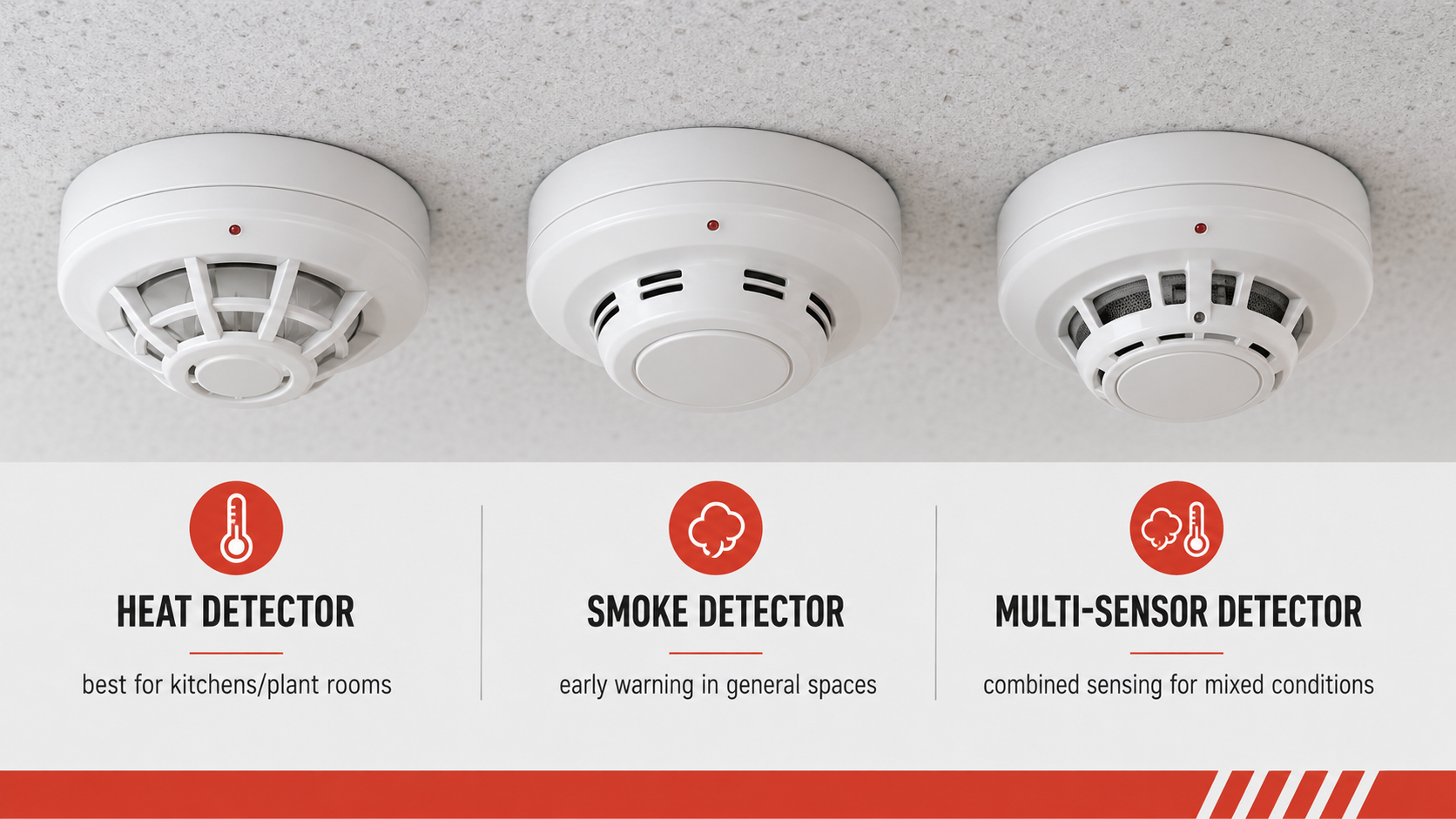
Not every detector suits every space, and putting the wrong type in the wrong room is one of the most common causes of false alarms.
Heat detectors respond to a rise in temperature and are the right choice for kitchens, plant rooms, and other areas where steam, cooking fumes or dust would trigger a smoke detector unnecessarily.
Smoke detectors respond to smoke particles and give the earliest possible warning in most general spaces, offices, corridors, storerooms.
Multi-sensor detectors combine both heat and smoke sensing in one unit, reducing false alarms in spaces with mixed or unpredictable conditions, at a higher unit cost than a single-sensor detector.
Getting this mix right across a building matters as much as choosing the category or system type, and it's the same logic that applies to selecting the right fire extinguisher for a given fire risk, which we cover in our guide to the types of fire extinguisher your business needs.
How Often Should Commercial Fire Alarm Systems Be Tested and Serviced?
A fire alarm system needs a weekly manual call-point test and a six-monthly professional service to stay compliant with BS 5839. The weekly test, checking a different call point each week so every one gets tested across a roughly quarterly cycle, can be done by a competent member of staff and takes minutes.
The six-monthly service is more thorough (detectors, batteries, wiring, panel functions) and must be carried out by a certified, competent fire alarm engineer, typically BAFE-registered.
Records of both matter as much as the tests themselves: if a fire risk assessor, insurer, or fire authority asks for evidence of compliance, a logbook showing consistent weekly checks and six-monthly services is what they'll expect to see.
Conclusion
Choosing a fire alarm system comes down to three decisions, in order: which BS 5839-1 category your fire risk assessment calls for, whether conventional, addressable or wireless technology fits your building, and a testing routine that keeps you compliant once it's installed. Getting any one of those wrong either under-protects the building or creates a compliance gap that's expensive to unpick later.
If you're specifying equipment for a live project, Tiger Supplies' trade account and bulk ordering make it straightforward to source compliant fire alarm systems at scale. For related reading, our guides to EN352 hearing protection and EN 397 hard hats cover the same standard-by-standard approach for other PPE categories.
Frequently Asked Questions
Is BS 5839-1 a legal requirement?
Not directly, no law names BS 5839-1 as mandatory. But the Fire Safety Order 2005 requires "suitable" fire detection, and BS 5839-1 is the recognised standard used to judge what's suitable, so in practice non-compliance is very hard to justify.
What is a competent person under BS 5839?
Someone with the training, knowledge and experience to correctly test, maintain, or design a fire alarm system to BS 5839, for weekly testing this can be a trained staff member; for six-monthly servicing it should be a certified fire alarm engineer.
What's the difference between Category L and Category P?
Category L systems protect life (people and escape routes); Category P systems protect property. A single building can have both, engineered together where the fire risk assessment identifies both needs.
What's the difference between conventional and addressable fire alarms?
Conventional systems identify which zone triggered; addressable systems identify the exact device. Addressable is generally used on larger or higher-risk sites where knowing the precise location speeds up the response.
How often should a fire alarm system be serviced?
At least every six months by a certified engineer, in addition to weekly in-house call-point testing.
Can a fire alarm system be in both L and P category?
Yes, many commercial systems are designed to combine L and P categories where a single building needs both life and property protection, rather than choosing one over the other.