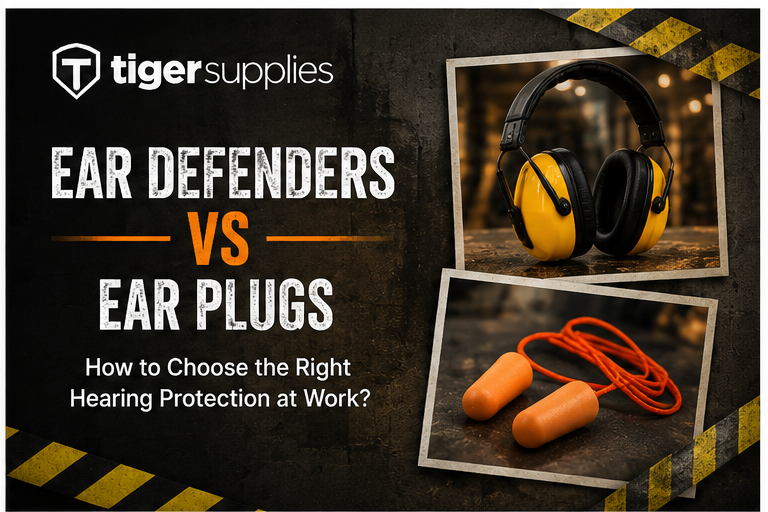
Ear Defenders vs Ear Plugs: How to Choose the Right Hearing Protection at Work?
Posted by Tiger Supplies on 1st Jul 2026
Hearing damage is one of the most under-reported workplace injuries in the UK.
Unlike a cut or a fall, noise-induced hearing loss builds up silently over months or years, and by the time it's noticed, it's usually permanent.
For businesses operating noisy sites, including construction, manufacturing, groundworks and warehousing, hearing protection is one of the few types of PPE where the wrong choice can have consequences long after the shift ends.
This guide covers what UK law actually requires, what the EN352 standard means on a product label, how ear defenders and ear plugs compare so you can choose correctly for your team, and how to read an SNR rating so you're not over- or under-protecting.
If you're sourcing hearing protection for a business rather than for personal use, this is written for you.
Is Hearing Protection a Legal Requirement In The UK?
Yes. Under the Control of Noise at Work Regulations 2005 (SI 2005/1643), UK employers have a legal duty to protect employees from hearing damage caused by workplace noise.
The regulations came into force for all industry sectors on 6 April 2006, and they set three clear noise thresholds employers must act on:
- 80 dB (lower exposure action value): the employer must assess the risk and make hearing protection available to anyone who asks for it.
- 85 dB (upper exposure action value): hearing protection becomes compulsory, and the area must be designated and signed as a Hearing Protection Zone.
- 87 dB (exposure limit value): this is the absolute ceiling, measured with protection factored in, and must never be exceeded.
Beyond providing PPE, the regulations place six specific duties on employers: assess the noise risk, take action to reduce exposure at source where possible, provide hearing protection where reduction isn't enough, enforce compulsory use in designated zones, train and inform staff, and carry out health surveillance where there's an identified risk.
Meeting these duties isn't just about handing out ear defenders, though, the protection itself has to be verified as compliant, which is exactly what our UKCA and CE marking rules for PPE guide walks through. Non-compliance isn't just a safety issue, it's a direct breach of statutory duty that HSE can and does enforce.
What Does EN352 Certification Mean?
EN352 is the harmonised European (and UK-recognised) standard that any hearing protector must meet to legally qualify as PPE.
If a product doesn't carry an EN352 rating and CE/UKCA mark, it isn't verified to protect against workplace noise, it's just a noise-reducing accessory.
The standard splits into three parts based on protector type, and this split matters because it's exactly how you should be shopping:
- EN352-1: Ear defenders (ear muffs): rigid cups with cushioned seals, held on by a headband.
- EN352-2: Ear plugs: inserted directly into the ear canal.
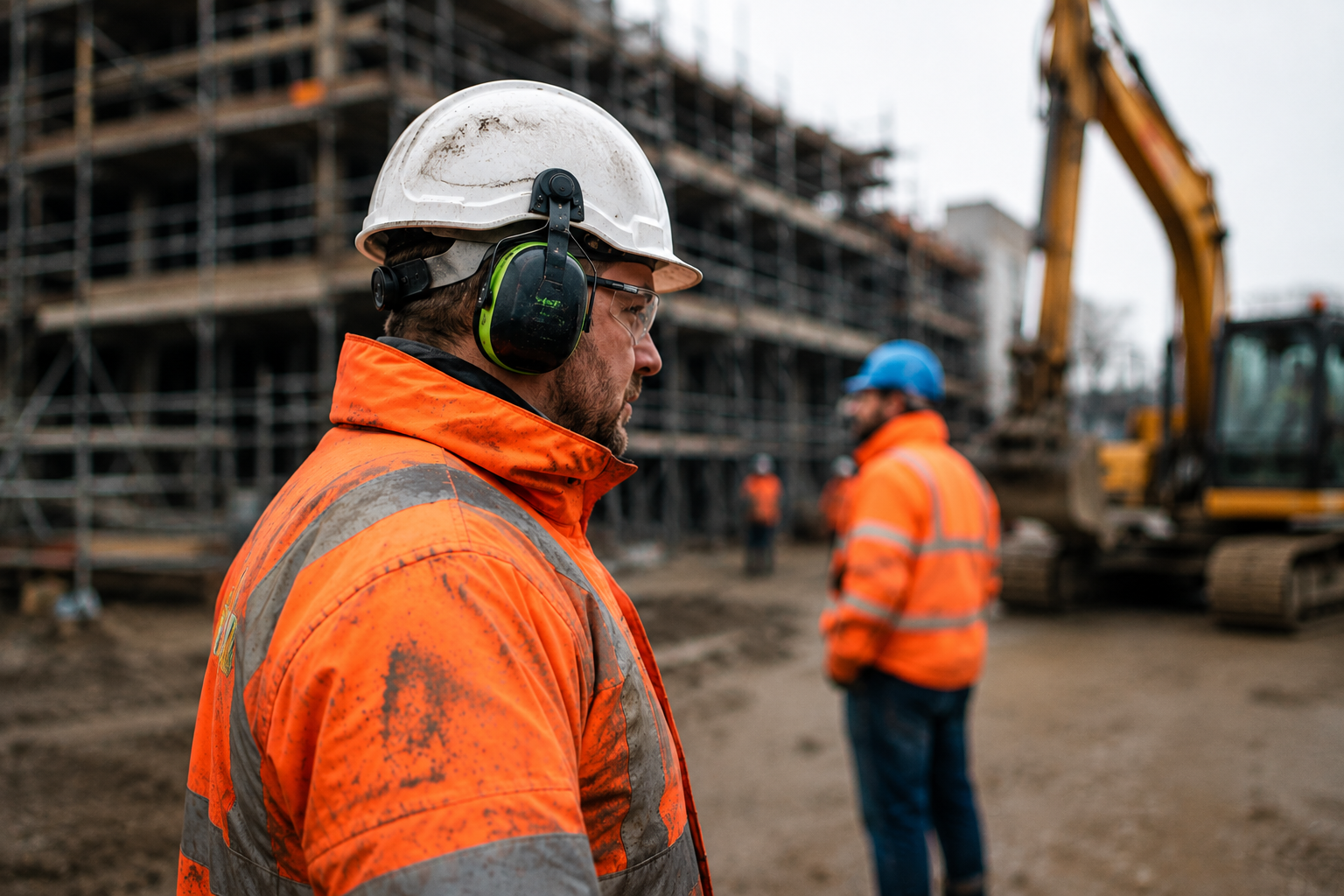
- EN352-3: Helmet-mounted ear defenders: the same cup mechanism as EN352-1, but designed to attach to a safety helmet with a parked (off-ear) position.
Every product on a genuine PPE supplier's site should state which EN352 sub-part it's certified to, alongside its SNR rating (covered in Section 5). If a listing doesn't state this, that's a red flag on compliance, worth checking before you buy, not after an audit.
Ear Defenders VS Ear Plugs: Which Is Right for Your Team?
There's no single "better" option between ear defenders and ear plugs, the right choice depends on how long your team wears protection, what else they're wearing on site, and how noise levels vary through the shift. Here's how the three main types compare:
|
Ear Defenders |
Ear Plugs |
Helmet-Mounted |
|
|
Best for |
Intermittent noise, shared/pool PPE |
Prolonged wear, hot environments |
Sites already wearing hard hats |
|
Comfort over a full shift |
Can feel warm after hours |
Comfortable long-term once fitted |
Same as ear defenders |
|
Hygiene |
Reusable, wipe-clean |
Best as single-use/disposable per wearer |
Reusable |
|
Supervision |
Easy to visually confirm compliance |
Harder to check at a glance |
Easy to visually confirm |
|
Typical cost per use |
Higher upfront, lower per-use |
Lower upfront, higher per-use if disposable |
Higher upfront, lower per-use |
Ear defenders are the right call when supervisors need to confirm compliance at a glance and when protection is shared across a rotating team, since there's no hygiene concern with a quick wipe-down between users.
Ear plugs work better for continuous, all-shift wear or in hot conditions where cups become uncomfortable, but because they sit inside the ear canal, they're better issued as single-use or personally fitted rather than shared.
For teams already in hard hats, groundworks, demolition, tunnelling, helmet-mounted ear defenders solve both problems at once: they clip onto the helmet you're already required to wear (see our EN 397 hard hat guide if you're reviewing headwear at the same time) and flip to a parked position the moment noise drops, so they're never left on a bench or lost.
Understanding SNR, H, M and L Ratings
Every EN352-certified protector carries an SNR (Single Number Rating), a single figure representing average noise reduction across all frequencies. It's the fastest way to check whether a product is adequate for a given environment: subtract the SNR from the measured noise level to estimate what actually reaches the ear. A workspace at 100 dB paired with an SNR 30 protector brings exposure down to roughly 70 dB, comfortably under the legal limits covered in Section 1.
|
Noise level |
SNR needed |
|
85–90 dB |
SNR 20 or below |
|
90–95 dB |
SNR 20–30 |
|
95–100 dB |
SNR 25–35 |
|
100–105 dB |
SNR 30+ |
Some protectors also list H, M and L values, which break that reduction down by frequency band, High (2,000–8,000 Hz), Medium (1,000–2,000 Hz), Low (63–1,000 Hz). This matters when the noise source is specific: low-frequency plant and machinery needs a strong L rating, while high-frequency alarms or power tools need a strong H rating. It's also worth avoiding unnecessary over-protection, a protector rated far above what the environment requires can block out spoken warnings and site alarms along with the noise, which creates its own safety risk.
How to Choose the Right Hearing Protection for Your Workplace
The right choice comes down to four questions, in this order:
1. What's the actual noise level?
Use the SNR table from Section 4 to work backward from your measured or estimated dB level, this determines the minimum SNR you need before comfort or format even enters the conversation.
2. How long is it worn per shift?
Ear plugs are the better call for continuous, all-day wear. Ear defenders suit intermittent exposure, where they're put on and taken off repeatedly through the day.
3. What else is your team already wearing?
On a construction site, hard hat compatibility usually decides the format before comfort does, if hard hats are already mandatory, helmet-mounted ear defenders remove a second separate item from the PPE checklist. Off-site or in warehousing, standalone ear defenders or plugs are simpler.
4. Who's using it, and how often does it change hands?
Shared, pooled equipment favours ear defenders, since they wipe clean between users. Personally issued, all-shift protection favours ear plugs, ideally single-use or individually fitted.
Run through those four in order and the right product for your team becomes obvious rather than a guess. You can browse our full range of ear protection filtered by SNR rating, or the full PPE range if you're specifying hearing protection alongside other kit for the same job.
Conclusion
Choosing between ear defenders, ear plugs, and helmet-mounted protection isn't really a preference call, it comes down to noise level, shift length, and what else your team is already wearing, all of which are covered above. Get the SNR right and the format matched to how the equipment is actually used, and you've met both the legal requirement and the practical one. If you're reviewing PPE more broadly, this sits alongside our other EN-standard guides, including our EN 374 chemical-resistant gloves guide and our EN ISO 20471 hi-vis clothing guide, if you're auditing compliance across your full kit list rather than just hearing protection.
Frequently Asked Questions
What do ear defenders do?
Ear defenders reduce noise reaching the ear by mechanically sealing rigid, cushioned cups over each ear. They don't block sound electronically, the reduction comes purely from the physical seal and cup material, which is why fit and cushion condition directly affect how well they perform.
How do ear defenders work?
The cups create a sealed air gap around the ear, and the shell material absorbs and reflects sound energy before it reaches the ear canal. The tighter and more complete the seal against the head, the closer the actual protection gets to the labelled SNR.
Is hearing protection classed as PPE?
Yes. Under UK regulations, any hearing protector, ear defenders, ear plugs, or helmet-mounted, is classed as personal protective equipment and must carry EN352 certification with CE or UKCA marking to be legally supplied and used as such.
Do ear defenders block out noise completely?
No, and they're not designed to. They reduce noise by their rated SNR, not to zero. Protectors that over-reduce sound below safe working levels can actually be counterproductive, since they can mask spoken warnings, alarms, and moving vehicles.
How often should ear defenders be replaced?
There's no fixed legal interval, but cushions should be checked regularly and replaced as soon as they're cracked, hardened, or no longer sealing fully against the head, a compromised seal reduces the actual SNR delivered, regardless of what the label states.
Can ear plugs and ear defenders be worn together?
Yes, this is a recognised approach called "double protection," used in extreme noise environments where a single protector can't bring exposure below the legal limits on its own. It should be specified deliberately for genuinely high-noise tasks, not used as a default.