EN 397 Hard Hats Explained: What the Standard Means and How to Choose the Right Safety Helmet
Posted by Tiger Supplies on 21st May 2026
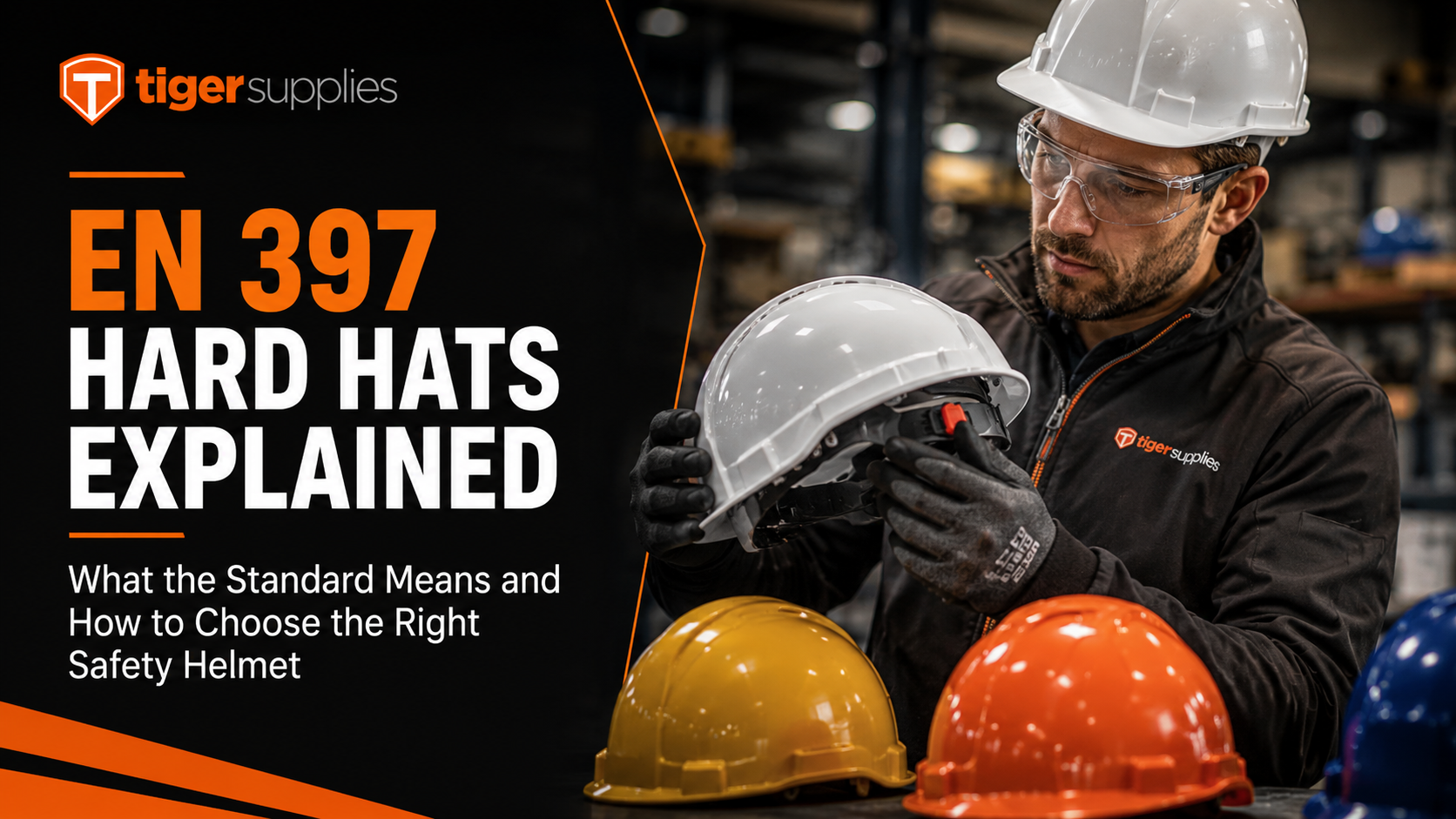
Being struck by a falling or moving object is one of the leading causes of fatal workplace injuries in the UK. A correctly rated hard hat is often the difference between a minor incident and a life-changing injury.
EN 397 is the European standard used to assess industrial safety helmets and forms the basis of hard hat regulations in the UK for construction, industrial, and manufacturing workplaces. It sets out the minimum performance a hard hat must meet before it can be used in the workplace.
This guide explains what EN 397 means, what the mandatory and optional tests cover, how the 2025 revision introduces new helmet types, and how to choose the right safety helmet for different workplace tasks. Browse our Hard Hats range or explore our wider PPE equipment for workplace safety essentials.
What Is EN 397?
EN 397 is the European standard for industrial safety helmets, often referenced as BS EN 397 in the UK. It is the minimum legal requirement for hard hats used on construction sites, factories, warehouses, and similar environments where there is a risk from falling objects.
For a hard hat to receive EN 397 certification, it must pass four mandatory tests:
|
Test |
What it measures |
Pass requirement |
|
Shock absorption |
Force transmitted through the helmet when struck by a 5 kg weight dropped from 1 metre |
Must not exceed 5 kN |
|
Penetration resistance |
Whether a 3 kg pointed object breaks through the shell when dropped from 1 metre |
Must not make contact with the head form underneath |
|
Flame resistance |
Whether the helmet self-extinguishes after exposure to flame |
Must self-extinguish within 5 seconds |
|
Chin strap retention |
Strength of the chin strap anchorage under load |
Must release between 150–250 N to prevent strangulation |
The EN 397 marking is usually moulded or printed inside the helmet shell, alongside the manufacturer name, year and quarter of production, helmet type, size, and shell material.
EN 397 Optional Markings: What the Extra Codes on Your Hard Hat Mean
Beyond the four mandatory tests, EN 397 includes optional performance ratings for specific workplace hazards. These are shown as codes printed alongside the EN 397 marking inside the helmet.
|
Marking |
What it means |
When you need it |
|
-20°C or -30°C |
Low temperature performance |
Outdoor winter work, cold stores |
|
+150°C |
High temperature resistance |
Foundries, welding, hot work |
|
440V AC |
Electrical insulation up to 440V |
Electrical installations, utility maintenance |
|
LD |
Lateral deformation (side impact) resistance |
Confined spaces, side-impact risks |
|
MM |
Molten metal splash resistance |
Welding, metalwork, foundry |
Two hard hats can both carry the EN 397 label but offer very different levels of protection. One may be rated for electrical insulation and lateral deformation, while another only covers the basic mandatory requirements. Always check the full marking inside the shell before issuing helmets to workers.
Tiger Supplies stocks EN 397 hard hats from JSP, Centurion, and Portwest with options across multiple protection levels and optional ratings.
EN 397:2025 Update: Type 1 and Type 2 Hard Hats Explained
The EN 397 standard was revised in 2025, introducing two helmet classifications for the first time.
|
Type |
Intended use |
What is tested |
|
Type 1 |
General industrial and ground-level construction |
Top-of-head (crown) impact only |
|
Type 2 |
Working at height, scaffolding, elevated platforms |
Crown impact + lateral impact + stronger retention |
Type 2 helmets now integrate requirements that were previously only found in EN 12492, the climbing helmet standard. This means a single helmet can cover both ground-level site work and elevated tasks, which simplifies procurement for sites where workers move between different risk levels.
Helmets certified to the previous EN 397:2012 remain valid until their CE or UKCA certification expires. There is no immediate need to replace existing stock. However, when purchasing new helmets, it is worth checking whether they meet the 2025 requirements, especially for teams that regularly work at height.
Hard Hat Colour Codes on UK Construction Sites
EN 397 does not mandate specific hard hat colours. However, Build UK introduced a standardised colour-coding system in 2017 to identify personnel by role across member construction sites.
|
Colour |
Typical role |
|
Black |
Site managers, supervisors |
|
White |
Engineers, client representatives |
|
Blue |
Skilled workers (electricians, carpenters, plumbers) |
|
Orange |
Slingers, signallers |
|
Yellow |
General labourers, visitors |
|
Green + sticker |
First aider |
|
Red + sticker |
Fire marshal |
These colours do not affect protection level. A blue EN 397 hard hat provides the same impact protection as a white one. The colour is purely for identification.
Non-Build UK sites, including Network Rail, may use different systems. Always confirm site-specific rules before issuing helmets. Stickers and decals can be used for additional role identification, but should not cover areas of the shell that need to be inspected for cracks or damage.
Tiger Supplies stocks hard hats in all standard colours as well as Hard Hat ID Tags and Stickers for on-site role identification.
Bump Caps vs Hard Hats: What Is the Difference?
Hard hats (EN 397) and bump caps (EN 812) are both forms of head protection, but they are designed for very different risk levels.
|
Hard hat (EN 397) |
Bump cap (EN 812) |
|
|
Protects against |
Falling objects, penetration, impact |
Minor bumps against fixed objects |
|
Tested with |
5 kg weight dropped from 1 metre |
Much lower impact energy |
|
Suitable for |
Construction, industrial, manufacturing |
Warehouses, workshops, low-clearance areas |
|
Chin strap |
Required or anchorage points provided |
Not always included |
A bump cap should never be used as a substitute for an EN 397 hard hat where falling object or penetration risks exist. If there is any doubt about the hazard level, default to an EN 397 helmet.
Browse Bump Caps for low-risk environments or Hard Hats for full EN 397 protection.
How Long Do Hard Hats Last?
Most manufacturers recommend replacing hard hats every 3 to 5 years from the date of manufacture, depending on material, usage, and exposure conditions. However, several factors can shorten that lifespan.
Replace a hard hat immediately if:
- It has received a significant impact, even if no visible damage is present
- The shell shows cracks, dents, fading, or a chalky surface texture
- It has been exposed to chemicals, solvents, or paints
- The date of manufacture is no longer readable
Factors that reduce lifespan:
- UV exposure from prolonged outdoor use or storage in direct sunlight
- Extreme temperatures, including storage in hot vehicles during summer
- Chemical contact from adhesives, cleaning products, or site materials
The date of manufacture is usually moulded into the underside of the peak or inside the shell. Check it regularly. If the helmet is within its service life but shows any signs of degradation, replace it regardless.
The EN 397:2025 update also places greater emphasis on manufacturers providing clear guidance on expected service life, which should make replacement decisions easier going forward.
How to Choose the Right Hard Hat for Your Workplace
The right hard hat depends on the specific hazards present, not just the job title. Two workers on the same construction site may need different helmets if one is working at ground level and the other on scaffolding.
|
Workplace or task |
What to look for |
Key markings |
|
General construction |
Impact and penetration protection, chin strap |
EN 397 |
|
Working at height |
Side impact, stronger retention |
EN 397 Type 2 (2025) or EN 12492 |
|
Electrical work |
Electrical insulation |
EN 397 + 440V AC |
|
Welding or foundry |
Molten metal resistance |
EN 397 + MM |
|
Cold environments |
Low temperature rated shell |
EN 397 + -20°C or -30°C |
|
Warehouse or logistics |
Basic overhead protection |
EN 397 or EN 812 bump cap |
Beyond the standard and markings, comfort matters. A hard hat that workers find uncomfortable is more likely to be removed or worn incorrectly. Look for features like ratchet adjustment, ventilation, and compatibility with other PPE such as ear defenders and visors.
Tiger Supplies stocks hard hat accessories designed to improve comfort and extend functionality:
- Hard Hat Sweatbands & Chinstraps for secure fit and moisture control
- Hard Hat Liners & Warmers for cold weather protection
- Hard Hat Visors for face and eye protection
- Hard Hat Ear Defenders for noise reduction on site
EN 397 Hard Hat FAQs
What does EN 397 mean on a hard hat?
EN 397 is the European standard for industrial safety helmets. It confirms the helmet has been tested for shock absorption, penetration resistance, flame resistance, and chin strap retention. In the UK, it is the minimum legal requirement for hard hats on construction and industrial sites.
How long do hard hats last in the UK?
Most manufacturers recommend replacing hard hats every 3 to 5 years from the date of manufacture. Replace sooner if the shell shows cracks, fading, or damage, or if the helmet has received a significant impact.
Do hard hats expire?
Hard hats do not carry a fixed expiration date, but they do degrade over time. UV exposure, extreme temperatures, and chemical contact all reduce the shell's integrity. Check the manufacture date moulded inside the helmet and follow the manufacturer's recommended service life.
Are hard hats mandatory on construction sites in the UK?
In most cases, yes. Under the Personal Protective Equipment at Work Regulations, employers must provide suitable head protection where there is a risk of head injury that cannot be controlled by other means. On almost all UK construction sites, hard hats are required.
What is the difference between EN 397 and EN 12492?
EN 397 covers general industrial safety helmets for ground-level work. EN 12492 covers helmets for working at height, with stronger retention and lateral impact testing. The EN 397:2025 update introduces Type 2 helmets that now bridge the gap between the two standards.
Are bump caps and hard hats the same?
No. Bump caps (EN 812) protect against minor knocks from fixed objects in low-risk environments. Hard hats (EN 397) protect against falling objects and penetration. A bump cap must never replace a hard hat where falling object risks exist.
Do hard hats need chin straps?
EN 397 requires that the helmet either includes a chin strap or provides anchorage points to attach one. On many UK sites, especially for work at height, chin straps are mandatory. The strap must release between 150–250 N to prevent strangulation.
What do hard hat colours mean on UK construction sites?
Build UK introduced a colour-coding system in 2017 to identify personnel by role. Black is typically for supervisors, white for engineers, blue for skilled workers, orange for slingers, and yellow for general labourers. These colours do not affect the helmet's protection level.
How do I check if my hard hat is still safe to use?
Inspect the shell for cracks, dents, fading, discolouration, or a chalky texture. Check the harness for fraying or loss of elasticity. Confirm the manufacture date is within the recommended service life. If in doubt, replace the helmet.
Where can I buy EN 397 hard hats in the UK?
Tiger Supplies stocks a full range of EN 397 certified hard hats from brands including JSP, Centurion, and Portwest. Browse the Hard Hats category or explore the complete PPE range for workplace safety equipment with next working day delivery.
Conclusion
EN 397 is the foundation of hard hat safety in the UK. Understanding what the standard covers, what the optional markings mean, and how the 2025 update changes helmet classification helps businesses make better procurement decisions and keep workers properly protected.
The key is always to match the helmet to the hazard. A basic EN 397 hard hat is sufficient for many construction and industrial tasks, but electrical work, welding, cold environments, and work at height each require specific optional ratings or helmet types. For complete site PPE compliance, see our guides to EN 388 safety gloves, EN 374 chemical protection gloves, and EN ISO 20471 hi-vis clothing.