Safety Harness Inspection Guide: How Often, What to Check and When to Replace
Posted by Tiger Supplies on 1st Nov 2026
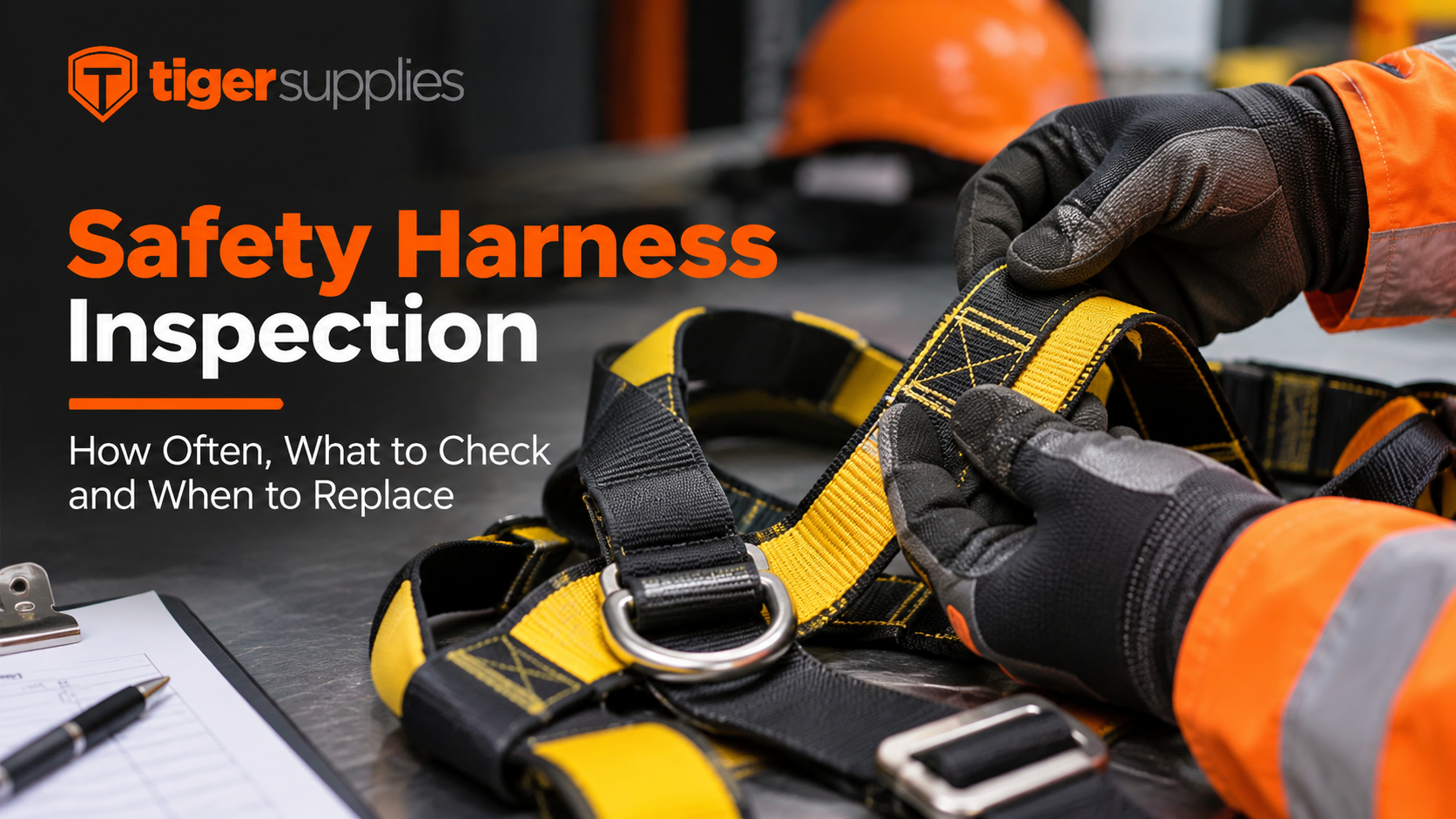
A safety harness needs a pre-use check before every use.
It must be inspected thoroughly by a competent person at least every six months, or every three months if it’s used frequently.
Safety harness inspection is the process of checking a harness and its connecting equipment for damage, so that anything unsafe is withdrawn before anyone relies on it in a fall.
This guide explains the UK legal requirements, how often each type of inspection is due, what to check on each component, when to replace a harness and how to record inspections.
Safety Harness Inspection Requirements in the UK
Safety harness inspection is a legal requirement.
Under regulation 12 of the Work at Height Regulations 2005, employers must make sure that work equipment exposed to conditions that cause deterioration is inspected at suitable intervals. It must also be inspected each time something exceptional happens that could affect its safety.
This covers personal fall protection systems, which are set out in Schedule 5 of the same regulations. The result of every inspection must be recorded and kept until the next inspection is recorded.
The Personal Protective Equipment at Work Regulations 1992 add a second duty. Regulation 7 requires personal protective equipment to be maintained in an efficient state and in good repair, which includes replacing or cleaning it as appropriate.
The standard for full body harnesses is BS EN 361:2002. A harness is only one part of the system, so fall arrest equipment inspection also covers the lanyards, connectors and energy absorbers used with it.
Who Should Inspect a Safety Harness?
The wearer carries out the pre-use check. Detailed and interim inspections must be done by a competent person: regulation 12 defines an inspection as one carried out by a competent person, and HSE guidance says the inspection regime itself should be drawn up by one.
A competent person harness inspection doesn’t have to come from an outside company. HSE says the inspector can be your own employee, provided they are independent and impartial enough to make objective decisions and have genuine authority to discard defective equipment. Many manufacturers and suppliers offer training in inspecting their own products.
How Often Should a Harness Be Inspected?
A safety harness should be checked by the wearer before every use and given a detailed inspection by a competent person at least every six months, or at least every three months if it’s used frequently.
This is the schedule set out in HSE leaflet INDG367. The leaflet is written for webbing lanyards but says many of its principles also apply to harnesses. Advice quoting 12 months for occasional use doesn’t match it. Harness inspection frequency can also depend on the manufacturer’s product-specific requirements, so check those too.
|
Inspection type |
When |
Who |
Recorded? |
|
Pre-use check |
Before every use |
The wearer |
Not required by HSE guidance |
|
Detailed inspection |
At least every 6 months, or at least every 3 months for frequent use |
Competent person |
Yes |
|
Interim inspection |
Between detailed inspections, where the risk assessment shows a risk of significant deterioration |
Competent person |
Yes |
Pre-Use Checks
The wearer carries out the pre-use check each time, before using the harness. HSE says it should be both visual and tactile, and done in good light. It should pick up cuts as small as 1 mm at the edges of the webbing, fibres that have softened or hardened, and contamination. If the wearer finds a defect, or has any doubt, the harness is withdrawn from use and passed to a competent person for a detailed inspection.
Detailed Inspections
A detailed inspection is a formal, more thorough examination of the equipment by a competent person. It uses the same defect criteria as the pre-use check but goes into more depth. HSE says any equipment with no evidence of a competent-person inspection in the last six months should be withdrawn from use.
Interim Inspections
Interim inspections fit between detailed inspections where your risk assessment shows the equipment could deteriorate significantly before the next one is due. HSE gives examples of demanding environments, such as work involving paints, chemicals or grit blasting. There’s no fixed interval: how often you need them depends on how the equipment is used.
Safety Harness Inspection Checklist
Work through the harness one component at a time, in good light, feeling the material as well as looking at it. The checklist below follows that order. Your team can also use it as a printable safety harness inspection checklist PDF.
Labels and Markings
Start with identification. The label must be present and readable so the harness can be identified and traced. It typically shows the manufacturer, model, serial number, date of manufacture and the standard the harness meets, which for a full body harness is BS EN 361. HSE says equipment should be withdrawn from use if its identification isn’t evident. It also says lanyards should be permanently marked in line with BS EN 365:2004, and that any lanyard still marked to the old BS 1397:1979 should be withdrawn.
Webbing and Straps
Check the full length of every strap, on both faces. HSE lists the defects to look for:
- cuts of 1 mm or more at the edges
- surface wear across the face of the webbing and at the loops
- chemical attack, which can cause local weakening and softening
- heat or friction damage, shown by fibres with a glazed appearance
- dirt, grit or sand worked into the webbing, which can wear the fibres from inside and out
Damage from sunlight (UV) is hard to spot by eye, but a powdery surface can be a sign of it.
Stitching
Stitched joints carry the load in a fall, so check each one for damage, including cuts, wear and broken threads. HSE lists damage to stitching as a defect that should take equipment out of use.
Buckles, D-Rings and Adjusters
Inspect every metal fitting, including the D-rings, buckles and adjusters. HSE treats damaged or deformed fittings as a defect. Look for bending, cracks, sharp edges and corrosion, and check that each buckle fastens and each adjuster holds as the manufacturer intends.
Lanyards and Connectors
Lanyard inspection uses the same webbing and stitching checks as the harness, plus two more. First, check karabiners, screwlink connectors and scaffold hooks for damage or deformation. Second, check the energy absorber: if it is partly deployed, for example with a short length of tear webbing pulled out, the lanyard must come out of service. HSE says withdrawn equipment should be destroyed or returned to the manufacturer, so keep spare karabiners and replacement fall arrest lanyards in stock.
Care and Storage
How a harness is cleaned and stored between inspections affects how long it keeps passing them. Employers must keep PPE maintained, including cleaned as appropriate. Regulation 8 also requires appropriate storage for PPE when it isn’t being used. Dirt, grit, chemicals, heat and sunlight all damage webbing, so clean equipment in line with the manufacturer’s instructions and store it dry, away from chemicals, heat sources and direct sunlight.
When to Replace a Safety Harness?
Replace a safety harness when it fails an inspection, when it has arrested a fall, or when you can’t confirm it’s safe. HSE’s criteria for withdrawing fall arrest equipment from use are:
- a defect has been found, or there is any doubt about its safety
- there’s no evidence of a competent-person inspection in the last six months
- its identification isn’t evident
- it has been used to arrest a fall
The last point applies even if the equipment looks undamaged. HSE says equipment that has arrested a fall should never be reused, and should be withdrawn immediately and destroyed or returned to the manufacturer.
There’s no fixed legal lifespan for a harness. HSE notes there’s no clear boundary, such as a set usable life, separating safe equipment from unsafe equipment, so its condition and the manufacturer’s information decide. Check the manufacturer’s instructions for any maximum service life, just as you would with hard hat expiry dates. When a harness is withdrawn, replace it with one suited to the work; you can compare fall arrest harnesses by type and fit.
Looking for Replacement Fall Protection Equipment?
Need to replace equipment that has failed an inspection? Tiger Supplies stocks harnesses, lanyards, karabiners and tool tethering for work at height, with free delivery on orders over £75 and next working day delivery on eligible orders. Browse the full range of fall protection equipment.
Conclusion
Safety harness inspection works on three levels: a pre-use check by the wearer before every use, a detailed inspection by a competent person at least every six months (or three if used frequently), and interim inspections where conditions are harsh. Check the label, webbing, stitching, metal fittings and any connected lanyards, and record every formal inspection. Withdraw a harness that fails a check, has no recent inspection on record, can’t be identified or has arrested a fall. There’s no legal expiry date, so condition, inspection history and the manufacturer’s information decide when a harness needs replacing.
Frequently Asked Questions
Do safety harnesses expire?
Not in law. UK regulations don’t set an expiry date for harnesses, and HSE says there’s no clear usable life that separates safe equipment from unsafe. A harness stays in service while it keeps passing inspections, unless the manufacturer sets a maximum service life or the harness has arrested a fall.
How long is a fall arrest harness good for?
As long as it keeps passing pre-use checks and detailed inspections and stays within any service life the manufacturer gives. Heavy use, contamination, chemicals, heat and sunlight all shorten that period, which is why harsh conditions call for interim inspections.
How to tell if a harness is out of date?
Check three things:
- The label: compare the date of manufacture with any service life in the manufacturer’s information.
- The record or tag: if the last detailed inspection was more than six months ago, HSE says the harness should be withdrawn from use.
- Its condition.
A missing or unreadable label also means the harness should come out of service.
Do safety harnesses need to be certified?
When you buy a harness, check its conformity marking and the manufacturer’s information; our guide to UKCA and CE marking explains what to look for. After that, there’s no legal certificate to renew. What the law requires is a competent-person inspection and a record of it.
How often should fall arrest equipment be inspected?
The same schedule applies across the whole system. Lanyards, connectors and energy absorbers need a pre-use check before every use and a detailed inspection at least every six months, or every three months if used frequently. HSE wrote this guidance for lanyards made from webbing or rope.
How to wear a safety harness?
Follow the manufacturer’s fitting instructions, because harness designs differ. Do the pre-use check first, then put the harness on, fasten every buckle and adjust the straps for a close fit. Wearers must also be trained: the Work at Height Regulations only allow a personal fall protection system to be used by people who have received adequate training, including in rescue procedures.