Steel Toe vs Composite Toe Boots: Which Is Right for Your Team?
Posted by Tiger Supplies on 14th Aug 2026
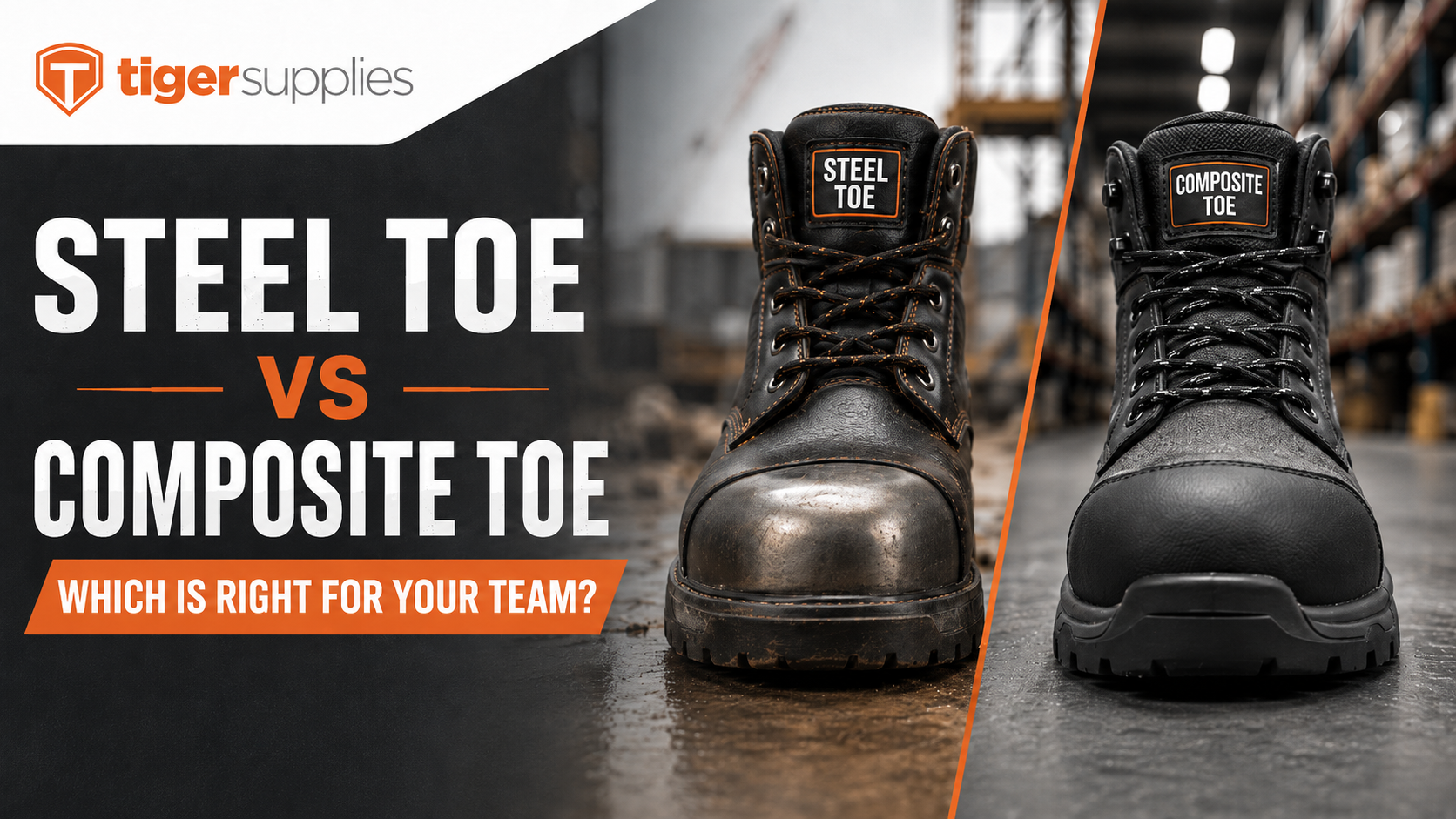
If you're choosing between steel toe and composite toe boots for your team, the short answer is: both meet the same UK safety standard, but they suit different jobs.
Steel toe caps are more compact, cheaper, and have a longer track record. Composite toe caps are around 30% lighter, don't conduct heat or cold, and won't set off a metal detector, making them the better choice for electrical work, food and pharmaceutical manufacturing, or roles where all-day comfort matters most.
This guide breaks down the real differences so you can specify the right toe cap for your team's environment, rather than guessing.
What's the Difference Between Steel Toe and Composite Toe Boots?
The core difference is the material used in the protective toe cap.
Steel toe boots use a metal insert, almost always steel to protect against impact and compression. Composite toe boots use non-metal materials such as fibreglass, carbon fibre, Kevlar or reinforced plastic to do the same job.
Both are tested to EN ISO 20345, the UK standard for safety footwear, and must withstand an impact of 200 joules and a compression force of 15,000 newtons to be sold as certified protective footwear.
Neither material is inherently "safer," the certification, not the metal, is what guarantees protection.
The practical difference comes down to weight, temperature conductivity, and where the boot needs to perform.
What Are the Pros and Cons of Steel Toe Caps?
Steel toe caps offer strong, well-established protection at a lower cost than composite alternatives, but they're heavier and conduct temperature.
Pros:
- Lower cost than composite equivalents, useful for bulk team orders
- Slimmer toe box, so more room inside the boot for a natural fit
- Decades of proven use across UK construction and industrial sites
- Widely available across every boot style, from dealer boots to rigger boots
Cons:
- Heavier than composite, which can add to fatigue over a full shift
- Conducts heat and cold, uncomfortable in extreme site conditions
- Will trigger a metal detector, a problem on food, pharma or secure sites
- Once compressed by a severe impact, a steel cap can stay dented rather than flexing back
What Are the Pros and Cons of Composite Toe Caps?
Composite toe caps are lighter, non-conductive, and won't set off a metal detector, but they typically cost more and take up slightly more space in the boot.
Pros:
- Around 30% lighter than steel, reducing fatigue on long shifts
- Non-conductive, safer for roles working near live electrical equipment
- Doesn't set off metal detectors, important for food, pharmaceutical and manufacturing sites with detection points on the production line
- Doesn't transfer outside temperature into the boot, more comfortable in extreme heat or cold
Cons:
- Bulkier toe box than steel, which can affect fit in narrower boot styles
- Generally more expensive than a steel toe equivalent
- Slightly thicker cap needed to match steel's impact resistance, adding minor bulk
Is Composite Toe as Safe as Steel Toe?
Yes. Any composite toe boot certified to EN ISO 20345 meets exactly the same impact (200 joule) and compression (15,000 newton) requirements as a steel toe boot. The certification, not the material, determines the safety rating, so a certified composite toe boot is not a lower-safety alternative to steel.
The main practical disadvantages of composite toe boots aren't about safety, they're cost and toe box bulk. In rare, very high-energy impact scenarios beyond the tested standard, steel may hold its shape slightly better, but within the certified S1–S5 ratings both materials are treated as equivalent by UK regulations.
Which Industries Should Choose Composite Toe Boots?
Composite toe boots are the better default for electrical and utility work, food, pharmaceutical and manufacturing environments with metal detection at goods-in or goods-out points, and any role involving long shifts on hard standing where weight-related fatigue is a concern.
Steel toe remains a cost-effective, reliable choice for general construction, groundwork and warehousing roles that don't have these specific requirements, it's the more economical option when ordering safety boots in bulk for a large team.
Does Toe Cap Material Affect EN ISO 20345 Compliance?
No. EN ISO 20345 tests the finished boot's performance, not the toe cap material specifically. Both steel and composite toe caps must pass identical impact and compression tests to carry the same S-rating (S1–S5).
The material is recorded in the product specification for buyers who need to avoid metal (for detection or conductivity reasons), but it has no bearing on the boot's certified protection level. A composite toe boot rated S3 offers the same guaranteed protection as a steel toe boot rated S3.
Steel Toe vs Composite Toe: Which One Should You Choose?
|
Steel Toe |
Composite Toe |
|
|
Weight |
Heavier |
~30% lighter |
|
Cost |
Lower |
Higher |
|
Conducts heat/cold |
Yes |
No |
|
Metal detector safe |
No |
Yes |
|
Suited to electrical hazard roles |
Not recommended |
Better suited |
|
Toe box bulk |
Slimmer |
Slightly bulkier |
|
EN ISO 20345 protection level |
Same |
Same |
|
Best for |
General construction, groundwork, cost-sensitive bulk orders |
Electrical/utility work, food & pharma manufacturing, all-day wear roles |
For most general site teams, steel toe remains the practical, cost-effective default. For electrical, food-grade or comfort-priority roles, composite is worth the extra cost. If you're specifying footwear for a mixed team, it's common, and perfectly compliant, to order both types across different roles from our full range of protective footwear.
If ankle support and boot style are also part of your decision, our rigger boots vs safety boots guide covers that comparison in detail.
Conclusion
Choosing between steel toe and composite toe comes down to your team's environment, not safety, both are certified to the same UK standard. Steel toe is the practical, budget-friendly choice for general site work; composite toe earns its higher price on electrical, food-grade or all-day-wear roles. Browse our full range of steel toe and composite toe safety boots, all EN ISO 20345 certified, with free UK delivery on orders over £75.
Frequently Asked Questions
What's better, steel toe or composite toe?
Neither is universally better, both meet the same EN ISO 20345 protection standard. Steel toe is cheaper and slimmer-fitting; composite toe is lighter, non-conductive and metal-detector safe. The right choice depends on your team's role and site conditions.
Can you wear composite toe boots in place of steel toe?
Yes. As long as the composite toe boot carries the same EN ISO 20345 S-rating as the steel toe boot it's replacing, it provides equivalent certified protection and is a fully compliant substitute.
Are composite toe boots certified to the same standard as steel toe in the UK?
Yes. Both must be tested and certified to EN ISO 20345, the UK standard for safety footwear, covering the same impact and compression requirements regardless of toe cap material.
Can composite toe boots go through a metal detector without triggering it?
Yes. This is one of the main practical reasons businesses choose composite toe boots for food, pharmaceutical and manufacturing sites, the non-metal cap won't set off detection equipment at production or goods points.