Rigger Boots vs Safety Boots: Which Do You Need for the Job?
Posted by Tiger Supplies on 21st Jun 2026
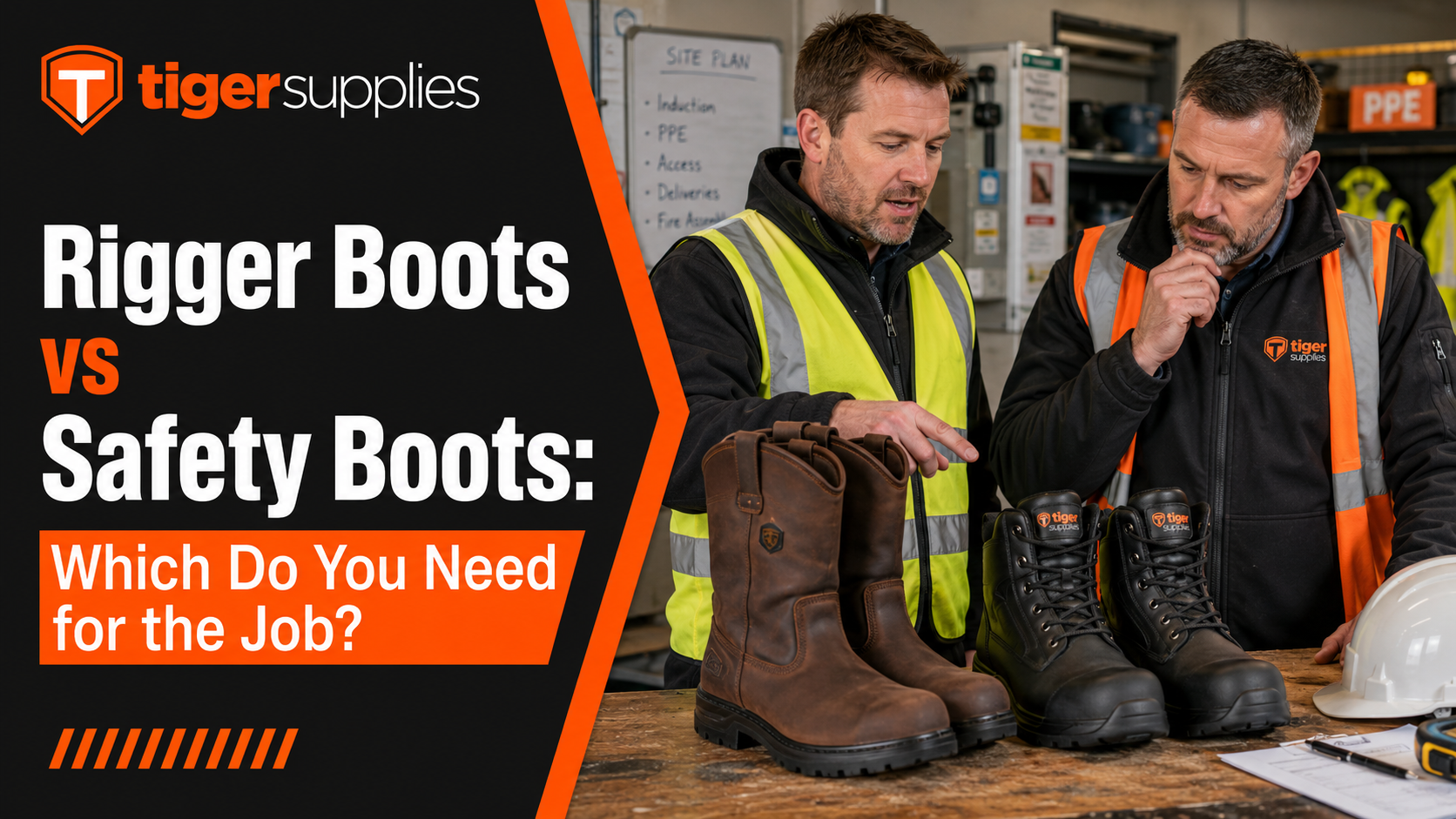
If you're deciding between rigger boots and safety boots, the short answer is: both protect your feet, but they're built for different situations.
Rigger boots are pull-on safety boots - quick to get on and off, naturally waterproof, and suited to operatives who move between site, plant and welfare facilities throughout the day. Traditional safety boots use a lace-up or zip fastening for a more secure, adjustable fit with greater ankle support.
Both types can meet EN ISO 20345, so the difference isn't about which is safer - it's about which is right for your role, your site conditions, and your employer's PPE rules.
This guide covers the key differences, which industries favour each type, and the one site rule question that catches most people off guard.
Key Differences Between Rigger Boots and Safety Boots
Design and Fit
Rigger boots are pull-on with a wide opening, elasticated sides and pull loops, originally designed so oil rig workers could remove them quickly in an emergency. That heritage explains their shape: fast on, fast off, with a looser fit around the ankle and calf.
Traditional safety boots close with laces, a side zip, or both. The fastenings hold the boot firmly to the foot, allow adjustment for different foot widths, and create a stable base when walking on rough or uneven ground.
For general groundwork, utilities, and flat-terrain site work, the pull-on design of rigger boots is a genuine practical advantage. For jobs involving variable terrain, climbing or extended walking, the adjustable fit of a lace-up tends to perform better.
Ankle Support
This is the most important functional difference, and the one most likely to influence your employer's PPE policy.
Rigger boots sit below or at the ankle, providing minimal lateral support. On flat, stable ground this is rarely a problem. On uneven ground, scaffolding, or where workers are stepping on and off machinery, lower ankle support increases the risk of twists and sprains.
Traditional safety boots extend higher above the ankle and hold the foot in place with fastening. For roles involving variable terrain or elevated work, that support matters.
If your role keeps you largely on flat, stable ground, and your site permits it, rigger boots are a practical and comfortable choice. If you're regularly on uneven terrain or elevated platforms, lace-up boots offer measurably better protection.
Safety Ratings - What Do S1, S2 and S3 Mean?
Both rigger boots and traditional safety boots fall under EN ISO 20345, the UK standard for safety footwear. Within that standard, the S-rating tells you which protections are built in:
|
Rating |
Steel/Composite Toe Cap |
Energy Absorption (Heel) |
Water Resistance |
Anti-Penetration Midsole |
|
S1 |
✅ |
✅ |
❌ |
❌ |
|
S2 |
✅ |
✅ |
✅ |
❌ |
|
S3 |
✅ |
✅ |
✅ |
✅ |
Most rigger boots are rated S5, which includes water resistance and a penetration-resistant midsole, making them well-suited to outdoor and wet site environments. Many lace-up safety boots come in S1 or S3 depending on the intended use.
When ordering for a team, always confirm the minimum S-rating your site or industry requires before selecting a boot style. Our rigger work boots each carry their EN ISO 20345 rating in the product specification so you can check compliance before ordering.
Are Rigger Boots Banned on Construction Sites?
Rigger boots are not universally banned on UK construction sites, but many principal contractors prohibit them due to ankle support concerns. Whether you can wear them depends on your employer's PPE policy and the risk assessment for your specific role. For a full breakdown of site rules and how different contractors approach this, read our guide to rigger boot site rules and uses.
If your site does restrict rigger boots, our protective footwear range includes lace-up and zip-up safety boots across S1, S2 and S3 ratings, all EN ISO 20345 certified for UK site compliance.
Rigger Boots VS Safety Boots: Which Is Right for Your Role?
Choose Rigger Boots If…
… your role calls for speed, practicality and outdoor durability, and your site permits them. Rigger boots tend to work best in these situations:
- You work in groundworks, utilities or outdoor maintenance - flat terrain, frequent boot removal, wet conditions
- You move between site, vehicles and welfare facilities repeatedly throughout the day - pull-on design saves time and reduces frustration
- Your site operates on stable, level ground - where ankle support is less of a concern
- You need built-in waterproofing as standard - most rigger boots are inherently water-resistant without a separate waterproof lining
- Your employer's PPE policy permits them - always the deciding factor
Rigger boots are the preferred choice across construction groundworks, civil engineering, agricultural work, waste management and utility maintenance in the UK.
Choose Safety Boots If…
…your role involves higher-risk terrain, elevated work, or a site where rigger boots aren't permitted. A lace-up or zip safety boot is the stronger choice in these scenarios:
- Your role involves scaffolding, ladders or elevated platforms - ankle support is non-negotiable
- You walk on uneven, loose or variable terrain throughout the day - lace-up design keeps the boot anchored to your foot
- Your site or employer has a no-rigger-boots policy - common on larger principal contractor sites
- Your role requires S3 anti-penetration protection - more commonly found in lace-up styles
- You need electrical hazard (EH) rated footwear - specific to certain industrial environments
Rigger Boots vs Safety Boots - At a Glance
If you need a quick reference before ordering, use this comparison table.
|
Rigger Boots |
Safety Boots (Lace-Up/Zip) |
|
|
Fastening |
Pull-on |
Laces, zip or both |
|
Ankle support |
Lower |
Higher |
|
Waterproofing |
Usually built-in |
Varies by model |
|
Typical S-rating |
S5 |
S1, S2 or S3 |
|
Speed on/off |
Fast |
Slower |
|
Site ban risk |
Possible - check policy |
Generally accepted everywhere |
|
Best for |
Groundwork, utilities, flat terrain |
Scaffolding, variable terrain, high-risk roles |
|
EN ISO 20345 compliant |
✅ |
✅ |
Both types are available across our PPE range, with options for men's, women's, steel toe cap, composite toe and specialist site requirements.
Conclusion
Choosing between rigger boots and safety boots comes down to three things: your terrain, your role, and your site's PPE policy. For most groundwork, utility and outdoor trade roles, rigger boots are a practical, proven choice. For elevated work, uneven terrain or sites with a no-rigger-boots rule, a lace-up safety boot gives you the support and compliance you need. Browse our full range of rigger work boots or explore our wider protective footwear range, all EN ISO 20345 certified, with free delivery on orders over £75.
Frequently Asked Questions
What is the difference between rigger boots and safety boots?
Rigger boots are pull-on safety boots with a wide opening and no lacing - designed for easy removal and fast transitions on site. Traditional safety boots fasten with laces or a zip, providing a more adjustable, ankle-supporting fit. Both can comply with EN ISO 20345, but they suit different roles and terrain types.
Why are rigger boots banned on some construction sites?
Most site bans come down to ankle support. Rigger boots provide less lateral stability than lace-up boots, which increases slip and trip risk on uneven ground or elevated work areas. HSE doesn't explicitly ban rigger boots, but site-specific risk assessments often do. Always check your employer's PPE policy before purchasing.
Who wears rigger boots?
Rigger boots are most commonly worn by groundworkers, civil engineering operatives, utility workers, agricultural workers and general site labourers who work on flat, stable terrain and need to remove their boots frequently throughout the day. They were originally developed for offshore oil rig workers, hence the name.
Are rigger boots warm?
Standard rigger boots are not insulated. However, fur-lined and fleece-lined rigger boots are widely available and provide significant warmth for outdoor winter work. If warmth is a priority, look for boots with a thermal or fur lining listed in the product specification. Our rigger work boots range includes lined options suitable for cold-weather site work.
Do women's rigger boots fit differently?
Yes. Women's rigger boots are built on a narrower last with a slimmer heel and adjusted calf width to reflect female foot shape. Wearing men's rigger boots in a smaller size is not the same, the proportions are different and can cause rubbing or instability on site. If you're equipping female operatives, always order from a women's-specific fit where available.