Do You Need Ear Defenders With Your Hard Hat?
Posted by Tiger Supplies on 7th Aug 2026
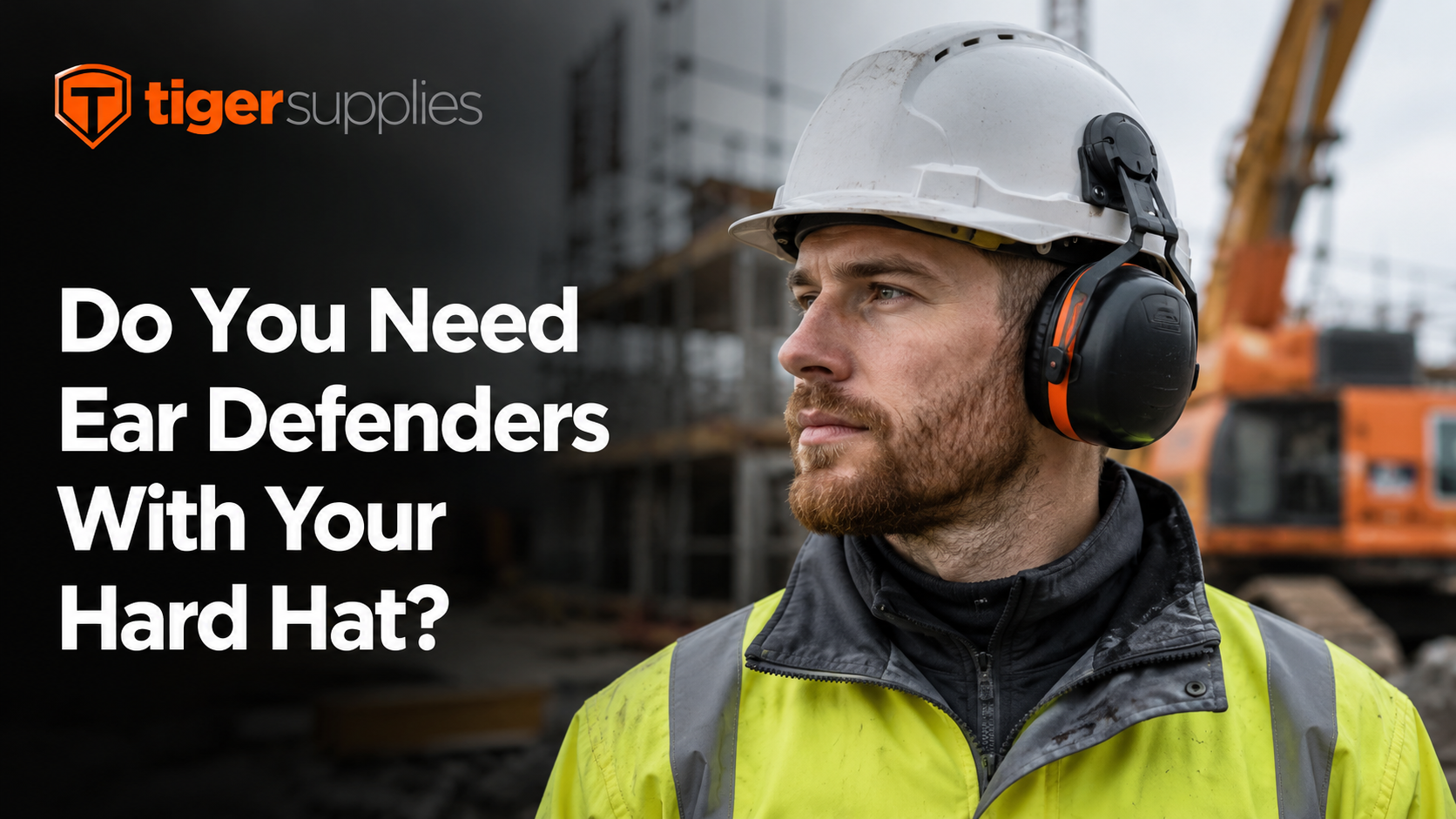
If you're only dealing with the usual bumps and falling-object risks on site, your hard hat has you covered on its own.
But the moment you're working somewhere the noise regularly creeps up like plant running, demolition, groundworks, anything with sustained machinery, a hard hat alone won't protect your hearing.
You'd need ear defenders as well, and here's the catch: most standard ear defenders won't actually fit over a hard hat.
This guide covers when you need both, why compatibility matters more than people think, and how to get the fit right.
When Do You Actually Need Both?
Under the Control of Noise at Work Regulations, the HSE sets two thresholds that matter here:
- 80dB(A) - the "lower exposure action value." At this level, your employer has to assess the risk and make hearing protection available if you ask for it.
- 85dB(A) - the "upper exposure action value." Past this point, hearing protection isn't optional, it has to be provided and worn, usually in a marked hearing protection zone.
To put that in perspective: a road drill or a compactor plate can easily sit around 100dB, well past the point where damage happens fast.
If you're regularly on a site with a plant, power tools, or heavy machinery running nearby, you're very likely in that zone.
If you're mostly doing site walkarounds, admin, or lower-noise trades, the hard hat by itself is probably all you need, check with your site's noise assessment rather than guessing.
The Problem: Most Ear Defenders Don't Fit Over a Hard Hat
This is the part that catches people out. Standard over-the-head ear defenders - the kind with a headband that sits on top of your head - rely on that headband to hold the ear cups in place and keep the seal tight. A hard hat's shell sits in exactly the same spot.
Try to wear both together and you end up with a hard hat that won't sit properly, ear defenders that won't seal, or both, which defeats the point of wearing either.
This isn't a minor fit issue. If the ear cups aren't sealing properly against your head, you lose most of the noise reduction they're rated for, whether or not you can feel like you're wearing them.
Your Two Best Options
There are two proper ways to get compliant hearing protection while wearing a hard hat:
Helmet-mounted ear defenders
These clip directly into the mounting slots built into the sides of most hard hats, so there's no headband fighting with the helmet shell. You get a hard hat and hearing protection that are actually designed to work together, and you can flip the ear cups up when you don't need them without taking the helmet off.
Earplugs worn underneath the hard hat
Disposable or reusable plugs sit inside the ear canal, so they don't interact with the helmet at all. They're a good option if you find ear defenders too bulky for a full shift, though a well-fitted helmet-mounted defender generally gives a more consistent seal, plugs are more sensitive to how well they're inserted.
Neither option is "better" across the board. It depends on your site, your shift length, and what you find comfortable to wear all day; if you're still weighing it up, our full ear defenders vs ear plugs comparison breaks down the pros and cons of each.
Not All Ear Defenders And Hard Hats Are Compatible With Each Other
Here's the bit that trips a lot of people up even once they know they need helmet-mounted protection: you can't assume any pair of ear defenders will clip onto any hard hat.
Mounting points, slot widths, and attachment mechanisms vary by brand and even by model range within the same brand.
A pair designed for one manufacturer's helmet won't necessarily fit another's, and some hard hats don't have mounting slots at all, our guide to EN 397 hard hat standards covers what to check when choosing a helmet in the first place.
Before you buy, check that the ear defenders are listed as compatible with your specific hard hat model, most product listings will tell you which helmet ranges a given pair fits. If you're replacing a hard hat and keeping your existing ear defenders (or vice versa), it's worth double-checking rather than assuming.
How To Fit Ear Defenders To A Hard Hat
If you've got a compatible helmet-mounted pair, fitting them is straightforward:
- Locate the mounting slots on either side of your hard hat, usually a narrow channel just above the brim.
- Slide the ear defender's mounting arms into the slots until they click or lock into place.
- Swing the ear cups down over your ears, making sure the padding sits flat against your head with no gaps.
- Adjust the tension arm if your model has one, so the cups sit snugly without pinching.
- When you don't need them, swing the cups back up and out of the way, most helmet-mounted designs let you do this without removing the pair entirely.
To remove them for cleaning or replacement, reverse the process, most mounting arms release with a firm, straight pull rather than a twist.
Do Ear Defenders Actually Work?
Yes, but it's worth understanding what "working" means here. Ear defenders are rated with an SNR (Single Number Rating) - a figure in decibels that tells you roughly how much noise reduction you get when they're worn correctly.
A pair rated SNR 27, for example, doesn't block all sound; it reduces the noise reaching your ear by roughly that amount, which is usually enough to bring a loud site down to a safer working level.
They don't block out noise completely, and they're not meant to, you still need to hear alarms, shouted warnings, and reversing vehicles. What matters is that they're rated appropriately for your environment and, just as importantly, that they're fitted properly. An SNR 30 pair worn with a poor seal can perform worse than a lower-rated pair worn correctly.
Standalone Ear Defenders: When They're The Better Choice
If you're not wearing a hard hat at all, working in a workshop, a lower-risk area of a site, or anywhere head protection isn't required, standard over-the-head ear defenders are usually the simpler and more comfortable option. They're not competing with a helmet for space, so you get a wider range of styles and a more adjustable fit.
Save the helmet-mounted versions for when you genuinely need both types of protection at once. Ready to fit yours out properly? Shop our range of hard hat ear defenders, built to match your existing helmet without the fit problems standard ear defenders run into.
FAQs
Can you wear earmuffs under a hard hat?
Not in the sense of tucking a standard headband pair underneath the shell, there isn't room, and it'll stop the helmet sitting correctly. If you want hearing protection worn "under" the hard hat with nothing external, earplugs are the option; earmuffs need to be the helmet-mounted type that sits outside the shell.
What ear muffs can I wear over a hard hat?
Specifically, helmet-mounted ear defenders designed to clip into your hard hat's mounting slots, not standard headband ear defenders, which won't fit properly over the shell.
How do I remove ear muffs from a hard hat?
Pull the mounting arms straight out of the helmet's side slots, most designs release with firm, even pressure rather than a twisting motion. Check your specific model's instructions if it doesn't come free easily, as some use a slightly different locking mechanism.
Do ear defenders block out noise completely?
No, they reduce noise by an amount indicated by their SNR rating, not eliminate it. This is intentional, since you still need to hear alarms and spoken warnings on site.