FFP1 vs FFP2 vs FFP3 Masks: Which Respirator Do You Need?
Posted by Tiger Supplies on 1st Sep 2026
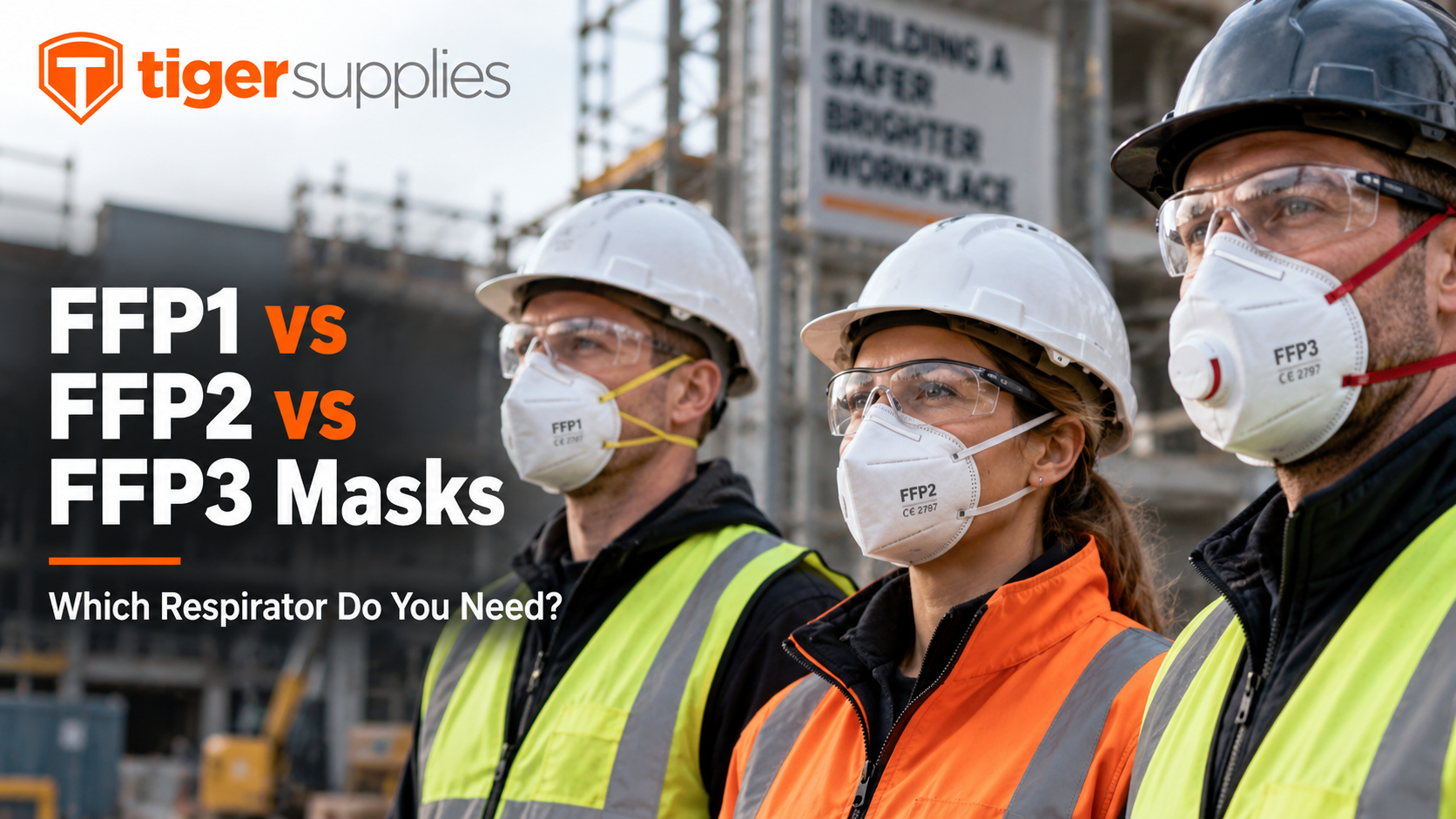
Dust, fumes and other airborne particles can cause serious health problems when the wrong respiratory protection is used. However, choosing between an FFP1, FFP2 and FFP3 mask is not simply a matter of selecting the highest number. The correct respirator depends on the airborne hazard, its concentration, the task being completed and the level of protection required.
FFP masks are classified under EN 149, the standard covering filtering half masks designed to protect against particles.
This guide explains the differences between FFP1, FFP2 and FFP3 masks, compares their filtration and protection levels, and helps you choose suitable masks and respirators for different workplace risks.
What Does FFP Mean?
FFP stands for Filtering Facepiece. An FFP mask is a tight-fitting, particle-filtering half mask classified under EN 149 as FFP1, FFP2 or FFP3 according to its filtration performance and total inward leakage.
FFP masks protect against particles, not gases or vapours. Where gases or vapours are present, employers must select RPE fitted with the appropriate filter for the identified substance and exposure level.
FFP1 vs FFP2 vs FFP3 at a Glance
The main difference between FFP1, FFP2 and FFP3 masks is the level of particle filtration and protection they are designed to provide. A higher class provides a higher level of protection, but only when the selected mask is suitable for the hazard, fits the wearer correctly and is used as instructed.
|
Class |
Minimum particle filtration |
Maximum total inward leakage |
UK assigned protection factor (APF) |
General protection level |
Example applications |
|
FFP1 |
80% |
22% |
4 |
Low-level exposure to lower-hazard particulates |
Certain low-risk tasks identified through an exposure assessment |
|
FFP2 |
94% |
8% |
10 |
Moderate particulate exposure |
Some construction, agricultural, pharmaceutical and industrial tasks |
|
FFP3 |
99% |
2% |
20 |
Higher-risk or finer hazardous particulate exposure |
Tasks involving high dust levels, silica or wood dust where the risk assessment specifies FFP3 protection |
These figures describe the performance classification of the respirator, not automatic approval for a particular job. Employers should identify the contaminant and exposure level through a suitable COSHH assessment, apply appropriate controls at source and then select RPE with an adequate protection factor. Tight-fitting FFP masks must also fit the individual wearer correctly.
FFP1 Masks Explained
An FFP1 mask provides the lowest level of protection under EN 149, with a UK assigned protection factor of 4. It may be suitable for low-level exposure to lower-hazard particulates where the risk assessment confirms that this protection is adequate.
FFP1 should not be treated as the default choice for construction work. Cutting, drilling, sanding and sweeping can produce significant dust, while silica and wood dust present more serious risks. FFP1 masks also do not protect against gases, vapours or oxygen-deficient environments.
FFP2 Masks Explained
An FFP2 mask provides an assigned protection factor of 10 and may be suitable for moderate particulate exposure in construction, manufacturing, agriculture and pharmaceutical environments. Selection must still be based on the substance, exposure level and workplace risk assessment.
For workplaces requiring this protection class, the Moldex Classic 2405 FFP2 valved masks conform to EN 149 and are available in boxes of 20. As with all tight-fitting RPE, each wearer must achieve an adequate seal and be face-fit tested for the specific make, model and size provided.
FFP3 Masks Explained
An FFP3 mask provides the highest level of particle protection within the EN 149 filtering-facepiece classes and has a UK assigned protection factor of 20. HSE recommends FFP3 for construction work that creates high dust levels or involves silica or wood dust.
Suitable FFP3 masks, such as the JSP FFP3V Moulded Mask with Valve, may form part of the controls for higher-risk cutting, grinding, drilling and sanding tasks.
An FFP3 dust mask does not make hazardous work automatically safe. Employers must control airborne contamination at source wherever reasonably practicable and select RPE for the remaining exposure. Suspected asbestos must be properly assessed before work begins, while welding fumes may require local exhaust ventilation and RPE selected for the specific process.
Drywall Dust: Which FFP Class Suits Each Task?
Drywall work creates fine gypsum dust, and the amount depends on the task. Cutting and fitting boards produce less dust than sanding joints, and dry sanding produces the most. The same respirator will not suit every stage, so match the class to each task on site.
For cutting and fitting boards in a ventilated space, FFP2 is often suitable where your risk assessment supports it. For sanding joint compound, particularly dry sanding or work in an enclosed room, FFP3 is generally the safer choice. FFP1 is not recommended for drywall sanding, as it gives the lowest protection in the range. For reusable half-masks with P3 filters, see our respirators and replacement filters.
Whichever class you choose, control dust at source first, because RPE should never replace it. Use wet sanding or a dust extractor where practical, and ventilate the room well. Then fit-test each wearer, as facial hair or a poor seal reduces protection whatever the class.
NR, R, D and V: What Do the Extra Letters on FFP Masks Mean?
Additional markings explain how an FFP mask has been tested or is intended to be used:
- NR means non-reusable. The mask is limited to one work shift and should be replaced sooner if it becomes damaged, contaminated, difficult to breathe through or unable to maintain its seal.
- R means reusable. The mask has met requirements for use across multiple shifts but must still be cleaned, inspected, stored and replaced according to the manufacturer’s instructions.
- D means dolomite-tested. The respirator has passed the dolomite dust clogging test, indicating greater resistance to clogging in dusty conditions. D does not mean reusable unless the mask is also marked R.
- V usually indicates a valve. Manufacturers commonly use V in product names for valved masks, but it is not a protection or reuse class. A valve may reduce heat and moisture but does not increase filtration performance.
For example, FFP3 NR D identifies a non-reusable FFP3 respirator that has passed the dolomite clogging test. Always check the complete product markings, instructions and declaration of conformity before purchasing or issuing RPE.
FFP Masks vs N95 and KN95: Are They the Same?
FFP2, N95 and KN95 respirators are often described as equivalents because their minimum particle-filtration requirements are similar. However, they are tested and certified under different standards, so the terms should not be treated as interchangeable.
|
Respirator class |
Standard or certification system |
Minimum particle filtration |
Important distinction |
|
FFP2 |
EN 149 |
94% |
EN 149 also assesses total inward leakage and other performance requirements |
|
N95 |
US NIOSH under 42 CFR Part 84 |
95% |
Certified under the American NIOSH system |
|
KN95 |
Chinese standard GB 2626 |
95% |
Manufactured and tested against the Chinese standard |
|
FFP3 |
EN 149 |
99% |
Higher EN 149 filtration class with a UK APF of 20 |
|
N99 |
US NIOSH under 42 CFR Part 84 |
99% |
Similar filtration percentage to FFP3 but certified under a different system |
In simple terms, FFP2 is broadly comparable to N95 and KN95 in filtration performance, while FFP3 and N99 both have minimum filtration levels of 99%. That does not make them identical. The standards use different test methods, approval systems and marking requirements, and real-world protection still depends on achieving an effective facial seal.
For UK workplaces, procurement teams should check the applicable PPE conformity and marking requirements, confirm that supporting documentation is available, and ensure the respirator is suitable for the identified hazard and required assigned protection factor. A stated filtration percentage alone is not enough to confirm that a product is suitable workplace RPE.
How to Select FFP Masks for Your Workforce
Selecting FFP masks for employees should begin with the workplace risk assessment, not a general assumption that one mask class will suit every task. The following factors should be considered before a product is purchased or issued:
- Identify the airborne hazard. Establish whether workers are exposed to dust, mist, fume, fibres, aerosols, gases or vapours. FFP masks protect against particles; gases and vapours require appropriately selected filters or a different type of respirator.
- Assess the exposure level. Compare the measured or reliably estimated exposure with the applicable Workplace Exposure Limit. This determines the minimum protection factor required. FFP1, FFP2 and FFP3 respirators have UK APFs of 4, 10 and 20 respectively.
- Control the hazard at source. Under COSHH, RPE should not replace reasonably practicable controls such as enclosure, water suppression or local exhaust ventilation. It is used to manage residual exposure after suitable control measures have been applied.
- Consider the task and wearing time. Work rate, temperature, humidity and the length of time the mask will be worn can affect comfort and consistent use. Valved masks may reduce heat and moisture, while demanding or prolonged work may require an alternative form of RPE.
- Check fit and workforce suitability. Tight-fitting respirators must match the wearer’s face. Employees using them should complete a face-fit test for the exact make, model, style and size they will wear. Facial hair along the sealing area can prevent an adequate seal, in which case loose-fitting RPE may need to be considered.
- Check compatibility with other PPE. Safety glasses, goggles, helmets and hearing protection must not interfere with the mask’s seal or straps. The complete PPE combination should be assessed rather than selecting each item separately.
- Standardise carefully. Using a controlled range of approved models can simplify procurement, training and replacement, but a single respirator model will not fit every employee. Businesses may need several sizes, shapes or models to accommodate the workforce properly.
- Plan inspection and replacement. Record which respirator each employee has passed a fit test with and ensure suitable stock remains available. NR masks must not be carried into another shift, while R masks require the cleaning, storage and inspection specified by the manufacturer.
Conclusion
Choosing between FFP1, FFP2 and FFP3 masks requires more than comparing filtration percentages. The correct choice depends on the airborne hazard, exposure level, required protection factor, task and individual wearer. Businesses should control contamination at source wherever reasonably practicable, select suitable RPE through the COSHH assessment and ensure every tight-fitting mask fits the person using it. This provides a safer and more consistent basis for protecting employees and purchasing respiratory protection.
Frequently Asked Questions
What does FFP3 mean?
FFP3 is the highest particle-filtration class under EN 149. It filters at least 99% of the test aerosol, permits a maximum total inward leakage of 2% and has a UK assigned protection factor of 20.
Is FFP3 better than FFP2?
FFP3 provides greater particle filtration and a higher assigned protection factor than FFP2. However, “better” depends on the hazard, exposure level, fit and task. The correct class must be selected through the workplace risk assessment.
What is the difference between FFP2 and FFP3 masks?
FFP2 masks filter at least 94% of the test aerosol and have a UK APF of 10. FFP3 masks filter at least 99% and have an APF of 20, providing a higher level of particle protection.
Can FFP masks be reused?
Check the product marking. NR masks are non-reusable and limited to one work shift. Masks marked R have met requirements for use across multiple shifts but must be cleaned, inspected, stored and replaced according to the manufacturer’s instructions.
Do FFP1 masks protect against dust?
FFP1 masks provide limited protection against particles and may be suitable for low-level, lower-hazard dust exposure where an APF of 4 is adequate. They should not be assumed suitable for construction, silica, wood or other hazardous dusts.
Is an FFP2 mask the same as an N95?
No. FFP2 and N95 respirators have similar minimum filtration requirements, but they are certified under different standards. FFP2 follows EN 149, while N95 respirators are approved under the American NIOSH certification system.