What Is PPE? The Definitive Guide to the 8 Types of Personal Protective Equipment and Who Must Provide It
Posted by Tiger Supplies on 21st Oct 2026
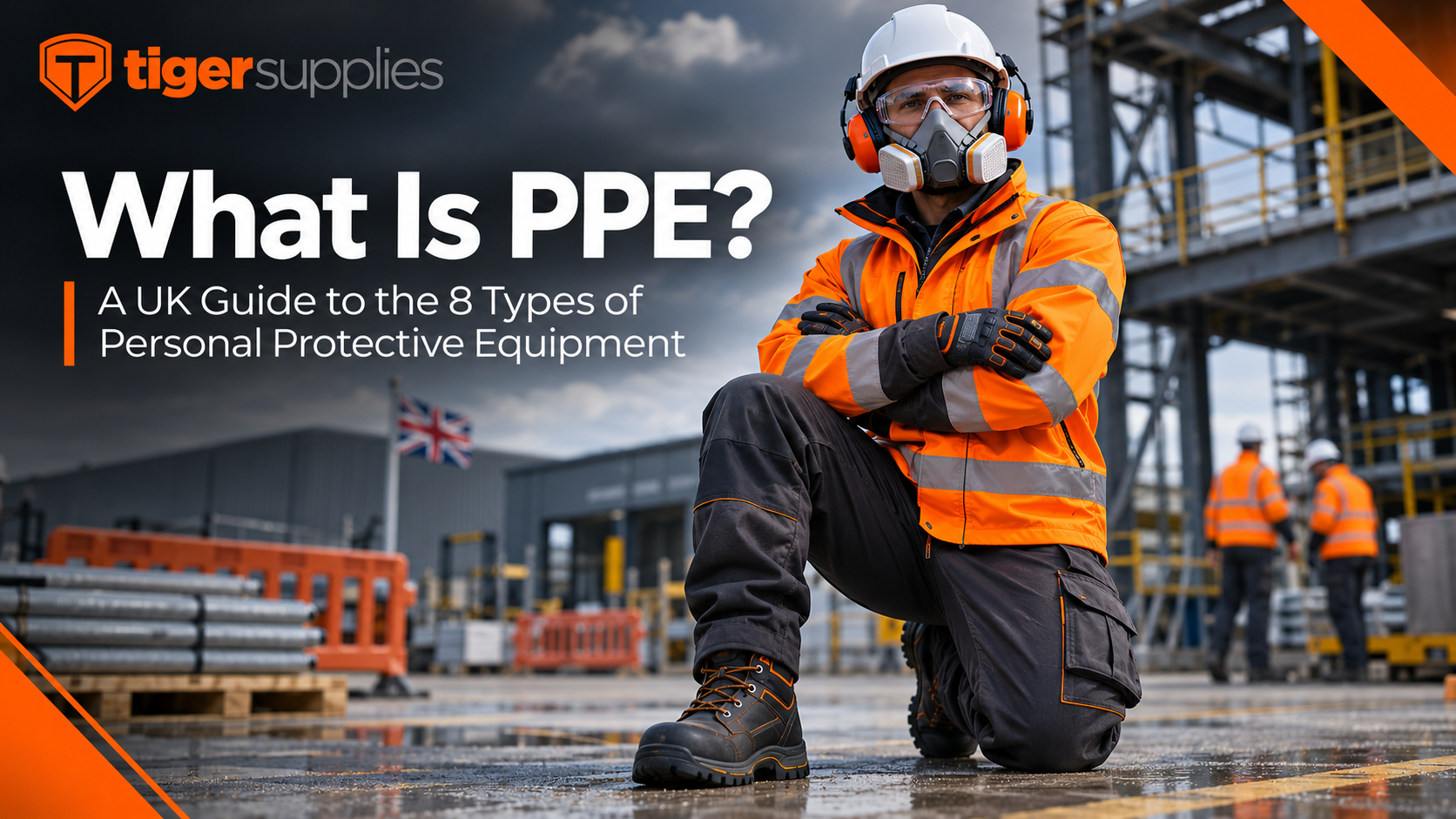
What does PPE stand for in health and safety? PPE stands for personal protective equipment: the clothing and equipment workers wear or hold to protect themselves from hazards that remain after other safety controls are in place. Hard hats, safety glasses, ear defenders, gloves, safety boots and harnesses are all examples of PPE.
The legal PPE definition comes from the Personal Protective Equipment at Work Regulations 1992: any equipment worn or held at work to protect against health and safety risks, including clothing that protects against the weather.
In this guide, we explain when PPE should be used and break down the 8 types of PPE, with the UK standard to check for each. We also cover what 5-point PPE means on construction sites, who is legally responsible for providing PPE, and how to choose, store, maintain and replace it so it keeps protecting your team.
When Should PPE Be Used?
Personal protective equipment should be used when your risk assessment shows that a hazard remains after every other reasonable control has been applied. The hierarchy of control sets the order. First, eliminate the hazard. Second, substitute a safer material or process. Third, isolate people from it with engineering controls such as machine guarding or local exhaust ventilation. Fourth, reduce exposure through safe systems of work, training and supervision. PPE comes last, to cover the risk that is left.
This is known as the PPE last resort principle, and it comes from the limitations of PPE. PPE protects only the person wearing it, not anyone else in the area. It also only works if it is the right type for the hazard, fits the wearer and is kept in good condition. A respirator that doesn’t seal, or a glove rated for the wrong chemical, gives almost no protection, and the wearer may not realise it has failed.
So why is PPE important if it comes last? On most sites and in most workshops, the risk that remains after other controls is still serious enough to cause injury or long-term ill health, and PPE is the final barrier against it. That is why personal protective equipment is important to choose from your risk assessment, not from habit or price alone.
HSE identifies the following situations where PPE is typically required:
-
breathing in dust, mist, gas or fume;
-
being struck by falling materials;
-
flying particles or splashes of corrosive liquid reaching the eyes;
-
skin contact with corrosive substances;
-
excessive noise;
-
extremes of heat or cold.
The 8 Types of PPE (with UK Standards)
Types of personal protective equipment are usually grouped by the part of the body they protect. Below are the eight main types of PPE used in UK workplaces, with examples of each and the standard to look for on the label or packaging.
Head Protection
Head protection guards against falling objects, impact and bumps. Industrial hard hats must meet EN 397. That standard covers construction, industrial and manufacturing sites where something could fall from above. Bump caps meet EN 812 and only protect against knocks on fixed objects, such as low beams or vehicle undersides. They must never be worn where there is a risk of falling objects. Check the markings inside the shell to confirm the standard and any optional ratings. Browse our Head Protection range.
Safety Eyewear
Eye protection guards against flying particles, dust, molten metal and chemical or liquid splashes. The three main types are:
- safety glasses for impact from the front;
- goggles for dust and splashes from every angle;
- visors and face shields for full-face cover.
Most UK eyewear is still certified to EN 166, and the marks on the frame and lens show what it has been tested for. EN 166 safety glasses markings are gradually giving way to EN ISO 16321, so check which standard your eyewear carries when you buy. Browse our Safety Eyewear range.
Ear Protection
Hearing protection is controlled by the Control of Noise at Work Regulations 2005. If a worker’s average daily exposure reaches 80 dB(A), the employer must make hearing protection available. At 85 dB(A), hearing protection must be worn, and the area must be marked as a hearing protection zone. Protectors are certified to EN 352:
- part 1 covers ear defenders;
- part 2 covers ear plugs;
- part 3 covers helmet-mounted defenders.
Our guide to [ear defenders vs ear plugs](URL TO CONFIRM) compares the two options. If your team also wears head protection, see hard hat with ear defenders. Browse our Ear Protection range.
Hi Vis Clothing
High-visibility clothing makes workers easier to see around vehicles, plant and moving machinery, especially in low light. It is certified to EN ISO 20471, which sorts garments into three classes:
- Class 1: the lowest visibility.
- Class 2: medium visibility, common for vests and waistcoats.
- Class 3: the highest visibility, needed around faster traffic.
Base the class you need on your risk assessment, not on the garment style. Our guide to EN ISO 20471 Class 1, 2 and 3 explains how to choose. Browse our Hi Vis Clothing range.
Masks & Respirators
Respiratory protective equipment (RPE) stops workers breathing in hazardous dust, mist, fumes and other airborne particles. Where hazardous substances are involved, RPE is mainly governed by COSHH rather than the PPE at Work Regulations. Disposable masks are classed under EN 149 as FFP1, FFP2 or FFP3, filtering at least 80%, 94% and 99% of particles respectively. Our guide to FFP1 vs FFP2 vs FFP3 masks helps you match the class to the hazard. Tight-fitting RPE only works if it seals to the face, so wearers need [face fit testing](URL TO CONFIRM). Browse our Masks & Respirators range.
Protective Footwear
Safety footwear protects against crushing injuries, sharp objects through the sole, and slips. It is certified to EN ISO 20345, which requires a protective toe cap and then grades additional protection. The most common ratings on UK sites are:
- S1: basic protection for dry conditions.
- S1P: adds a penetration-resistant midsole.
- S3: adds penetration resistance and water resistance.
Our guide to S1, S1P and S3 safety boot ratings explains which rating suits which job. Toe caps can be steel or composite and must pass the same tests; see steel toe vs composite toe boots. Browse our Protective Footwear range.
Gloves & Gauntlets
Hand protection is chosen by the type of risk:
- Mechanical hazards: EN 388 rates gloves for abrasion, cut, tear and puncture resistance. It also gives a cut rating from A to F and an optional impact mark. Our guide to EN388 glove ratings shows how to read the code.
- Chemical hazards: EN ISO 374 classes gloves as Type A, B or C depending on how many test chemicals they resist and for how long. See EN 374 chemical-resistant gloves.
A glove rated for one hazard is not automatically suitable for another. Browse our Gloves & Gauntlets range.
Fall Protection Equipment
Fall protection equipment stops a worker from falling, or stops a fall once it has started, when working at height. Under the Work at Height Regulations 2005, employers must first avoid work at height where they can, then prevent falls with measures such as guardrails. Personal fall protection is for what remains. A typical fall arrest system has three parts:
- a full body harness certified to EN 361;
- an energy-absorbing lanyard certified to EN 355;
- a suitable anchor point.
Wearers should check harnesses and lanyards before every use and take damaged equipment out of service straight away. Browse our Fall Protection Equipment range.
What Is 5-Point PPE on a Construction Site?
5 point PPE is the minimum kit most UK construction sites expect everyone to wear: a hard hat, hi-vis clothing, safety boots, gloves and eye protection. It is an industry convention, set out in site rules by principal contractors, not a legal list. No single regulation names these five items.
The law still requires construction PPE to be chosen from a risk assessment, so 5-point PPE is a baseline, not the full answer. Tasks such as cutting, drilling, demolition or working near noisy plant will often need respiratory or hearing protection on top.
PPE for construction can also vary from site to site. Footwear is a common example, because some sites restrict certain boot styles. Our guide answers the common question are rigger boots allowed on site.
Before workers arrive, check the principal contractor’s rules, because construction site PPE requirements are set at site level. PPE in construction is also one of the first things checked at induction.
Who Must Provide PPE in the UK, and Which Laws Apply?
Who is responsible for providing PPE? The employer.
So what are the requirements for PPE in the UK? PPE legislation sets them in three areas: what employers must do, what the equipment must meet, and which hazard-specific laws take priority.
Employer Duties for PPE
Three laws set out what employers must do:
- The Personal Protective Equipment at Work Regulations 1992 require employers to provide suitable PPE wherever a risk can’t be controlled by other means. These are what most people mean by “the PPE regs”.
- Section 9 of the Health and Safety at Work etc. Act 1974 means PPE must be free. Employers can’t charge for it, take a deposit or deduct the cost from wages.
- The PPE Regulations 2022 came into force on 6 April 2022. They extend the same duties to limb (b) workers, who are people who personally carry out work under a contract, often casually, without running their own business. So who is responsible for supplying employees with PPE now also covers most agency, zero-hours and gig workers. Genuinely self-employed workers must still provide their own.
PPE Product Requirements
Any PPE you buy must comply with Regulation (EU) 2016/425 as it applies in Great Britain. That regulation is enforced through the PPE (Enforcement) Regulations 2018. It is the manufacturer’s and supplier’s responsibility, but as the buyer you should check three things before issuing PPE to your team:
- a UKCA or CE mark;
- the relevant standard, such as EN 397 or EN 388;
- a declaration of conformity.
The 2018 Regulations revoked the Personal Protective Equipment Regulations 2002, so ignore any guide that still cites them. Our guide to UKCA and CE marking on PPE explains what to check on each item.
Hazard-Specific Regulations That Take Priority
Some hazards have their own law, and that law’s PPE rules apply instead of the 1992 Regulations:
|
Hazard |
Law whose PPE rules apply |
|
Hazardous substances (including RPE and chemical-resistant gloves) |
COSHH 2002 |
|
Noise (hearing protection) |
Control of Noise at Work Regulations 2005 |
|
Asbestos |
Control of Asbestos Regulations 2012 |
|
Lead |
Control of Lead at Work Regulations 2002 |
|
Radiation |
Ionising Radiations Regulations 2017 |
If your work involves any of these, follow that regulation’s PPE requirements for the hazard, and the 1992 Regulations for everything else.
Choosing and Using PPE: Employer and Employee Responsibilities
Supplying PPE is only the start. To protect people, PPE in the workplace has to fit, work with other kit and be worn correctly. The PPE at Work Regulations set out what employers must do to achieve that, and what workers must do in return.
Employer Responsibilities
- Carry out a PPE risk assessment (Regulation 6). Identify the risks that other controls can’t remove, and define what the PPE must protect against. Compare products against those needs. Review the assessment whenever tasks, equipment or staff change.
- Choose PPE that suits the wearer (Regulation 4). Match it to the hazard, the working conditions and the person, including fit, sizing and any health conditions. Trialling options with your team improves both fit and uptake.
- Check compatibility (Regulation 5). Items worn together must not reduce each other’s protection. For example, safety glasses can break a respirator’s seal, and helmet-mounted ear defenders must be compatible with the specific helmet model.
- Provide PPE training (Regulation 9). Explain the risks, how to wear and adjust the PPE, and how to check and look after it. Record who was trained and when, because that record is your evidence if HSE asks.
- Enforce correct use (Regulation 10). Take all reasonable steps to make sure PPE is worn properly, through supervision, spot checks and action on non-compliance.
Employee Responsibilities for PPE
PPE at work is a shared duty. Workers must:
- wear PPE as they were trained to and return it to storage after use (Regulation 10);
- report any loss or obvious defect straight away (Regulation 11).
Section 8 of the Health and Safety at Work etc. Act 1974 also bans intentionally or recklessly interfering with or misusing safety equipment, so workers must not alter PPE or remove parts from it.
PPE Storage, Maintenance, Inspection and Replacement
Regulations 7 and 8 of the PPE at Work Regulations require employers to store PPE properly, keep it clean and in good repair, and replace it when it stops protecting. Here is how to cover each duty.
PPE Storage
Store PPE somewhere clean and dry, away from sunlight, heat and chemicals. UV light weakens hard hat shells and harness webbing over time. Lockers, carry cases and wall-mounted dispensers keep kit protected and easy to find. Workers must return PPE to storage after use, so make sure the storage is close to where the work happens.
PPE Maintenance and Cleaning
Follow each manufacturer’s instructions, and give named people responsibility for PPE maintenance. Single-use items, such as NR masks, foam ear plugs and disposable gloves, are thrown away after use. Reusable items need a PPE cleaning schedule. Shared kit, such as respirators and ear defenders, should be cleaned between wearers.
PPE Inspection
Workers should check their PPE before each use for cracks, tears, worn parts, contamination and damaged straps or seals. Supervisors should back this up with regular spot checks. Fall arrest equipment also needs periodic detailed inspections by a competent person. Record the following in a PPE register and PPE issue record:
- inspection dates;
- who received what, and in which size;
- when each item is due for replacement.
These records give you an audit trail. Across multiple sites, they also keep products and sizes consistent.
When to Replace PPE
Replace any PPE that is damaged, contaminated or past the manufacturer’s service life. Use these triggers for each type:
|
PPE type |
Replace when |
|
Head protection |
After a significant impact, any damage, or at the end of its service life (see our guide to hard hat expiry date) |
|
Safety eyewear |
Lenses are scratched enough to impair vision, or the frame is damaged |
|
Ear protection |
Disposable plugs after each use; defender cushions when they harden or crack |
|
Hi vis clothing |
Colour fades, reflective tape is damaged, or the maximum wash cycles on the label are reached |
|
Masks & respirators |
NR masks at the end of the shift; filters as the manufacturer specifies or when breathing gets harder |
|
Protective footwear |
Tread is worn, the upper splits or the toe cap is exposed |
|
Gloves & gauntlets |
Damaged, contaminated, or the chemical breakthrough time is reached |
|
Fall protection |
After arresting a fall, or when any damage is found |
PPE Signs and Symbols
PPE signs are mandatory signs: a blue circle with a white symbol showing the PPE that must be worn beyond that point, as required by the Health and Safety (Safety Signs and Signals) Regulations 1996. Place each PPE sign at the entrance to the area where the hazard begins.
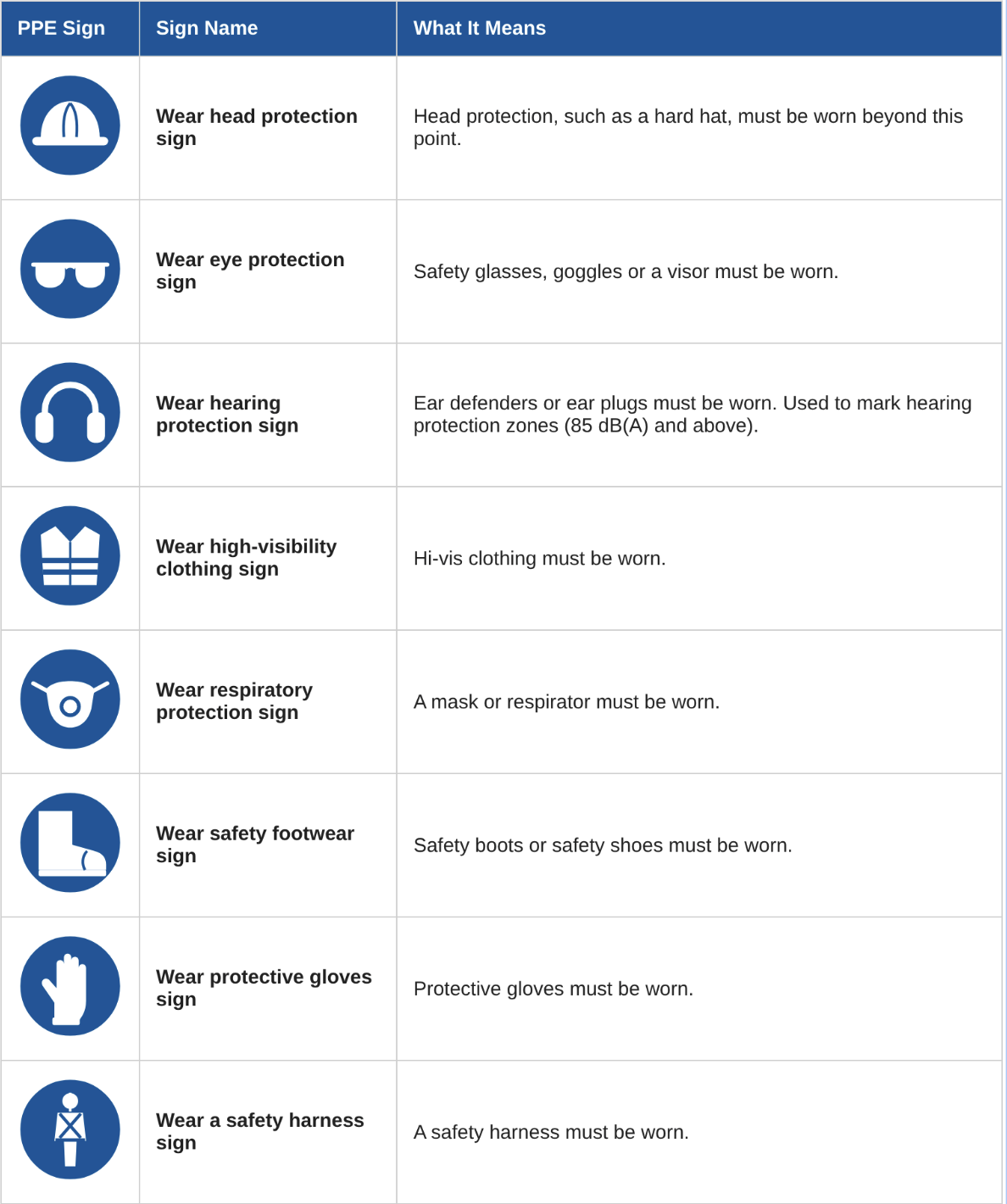
For other sign types and colours, see our guide to health and safety signs. For ready-made signage, browse our PPE signs range.
Looking for Compliant PPE for Your Team?
It’s easier to keep PPE consistent across every role and site when it all comes from one supplier. Tiger Supplies stocks PPE equipment in all eight types covered in this guide. Trade and bulk ordering keeps products and sizes consistent across teams, eligible orders get next working day delivery, and UK delivery is free on orders over £75. If your team uses tight-fitting respirators, we can also arrange on-site face fit testing.
Conclusion
PPE is your workers’ last line of defence against risks that other controls can’t remove. It covers head, eye, ear, hi-vis, respiratory, foot, hand and fall protection. Employers must provide it free to employees and limb (b) workers, and choose it from a risk assessment. They must also make sure items work together, train staff to use them, and keep everything stored, maintained, inspected and replaced. Workers must wear PPE as trained and report defects. Get these basics right, and your PPE will protect your team every time it is worn. Need help choosing PPE for your team? Our specialists are ready to help.
Frequently Asked Questions
Do employers have to provide safety boots?
Yes, if the risk assessment identifies a foot injury risk such as crushing, falling objects or sharp materials underfoot. Do employers have to pay for PPE such as safety boots? Yes. They can’t charge for it, take a deposit or deduct it from wages, and this applies to limb (b) workers too. Uniform shoes that don’t protect against a hazard aren’t PPE.
Why do some guides list 7 types of PPE?
Some guides combine body protection and fall protection into one group. We list fall protection separately because harnesses and lanyards have their own regulations, standards and inspection requirements.
Are hair nets PPE?
Not under the PPE at Work Regulations when they are worn for food hygiene. They protect the food, not the wearer. Food hygiene law, not PPE law, requires them.
Who enforces PPE law in the UK?
HSE enforces PPE law in most industrial workplaces, and local authorities enforce it in workplaces such as offices, shops and warehouses. Inspectors can issue improvement or prohibition notices and can prosecute. For detailed HSE PPE guidance, see HSE’s L25 guide to the PPE at Work Regulations.
Is personal protective equipment tax deductible?
For most businesses, PPE bought to protect workers is an allowable business expense. PPE an employer provides to meet health and safety duties is not normally a taxable benefit for the employee. Tax positions vary, so check with your accountant.